26 November, 2026
Thursday
MUSIC
George Michael's Faith Tour: A Concert 38 Years in the Making
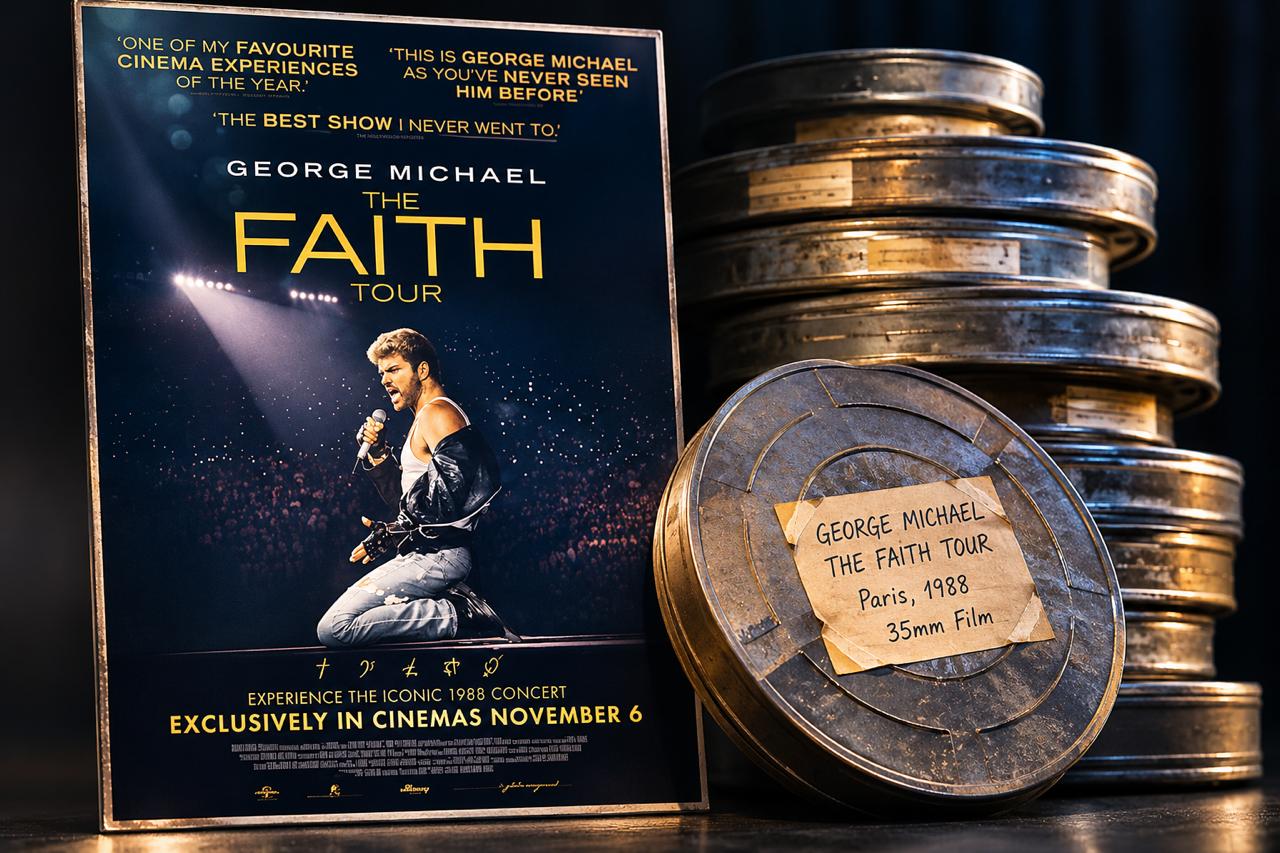
Last night I went to the cinema to see George Michael: The Faith Tour, a concert filmed in Paris in 1988 that has taken nearly 38 years to receive a proper release.
I knew the footage had been sitting in the archives for decades, but I wasn't quite prepared for just how extraordinary the experience would be.
Here was George Michael, at the height of his success, performing songs from one of the greatest pop albums of the 1980s.
The concert was filmed across two nights in Paris, with the audio originally recorded for radio broadcast. Although portions of the footage had appeared over the years, the complete concert film never received a proper release.
Now, almost four decades later, the footage has finally been restored and assembled into a spectacular concert film.
And what a concert it is.
Finding Faith: A Glimpse Into George's Mind
Before the concert begins, we're treated to a short documentary called Finding Faith, directed by Mary McCartney, daughter of Paul and Linda McCartney.
Mary is an accomplished photographer and filmmaker in her own right, having previously directed If These Walls Could Sing, a documentary about the legendary Abbey Road Studios.
Her involvement brings another interesting connection to music history.
The seven-minute film uses previously unheard recordings of George speaking about his career, alongside archival footage and previously unseen photographs taken by celebrated photographer Herb Ritts.
Rather than relying on contemporary interviews with people discussing George, Mary allows George to tell his own story.
Much of the audio comes from interviews recorded with journalist Tony Parsons around 1989 and 1990, giving us an intimate glimpse into George's thoughts during an extraordinary period of his career.
There's a particularly fascinating moment where George reflects on how he, Michael Jackson and Prince had all produced some of their most significant work at the age of 24.
Michael Jackson had released Thriller at 24. Prince had released 1999 at the same age. And George was 24 when Faith arrived.
Three extraordinarily talented artists, all producing career-defining music at an age when most people are still working out what they want to do with their lives.
What I particularly appreciated was hearing George reflect on his creativity, his ambitions and the extraordinary success he was experiencing at such a young age.
There's something quite moving about hearing him speak so candidly, knowing what would unfold over the following decades.
The documentary provides a thoughtful introduction to the concert, reminding us that behind the confident performer we're about to see was a young man navigating the enormous expectations that came with becoming one of the world's biggest pop stars.
And then the concert begins, and we see exactly why he deserved that success.
Faith: An Album That Was Almost Perfect
Watching the film reminded me just how brilliant George Michael's Faith album really was.
Released in 1987, it was his first solo album following Wham!, and in my opinion, it was close to perfection.
There was barely a weak moment on it.
The album effortlessly moved between pop, soul, funk, dance music and beautiful ballads. It was remarkably sophisticated, meticulously produced and filled with deeply personal themes.
It was also surprisingly adult.
I was only ten years old when Faith was released, happily singing along to songs about love, lust and relationships that were clearly written from a very adult perspective.
Looking back, I'm not entirely sure a ten-year-old should have been enthusiastically singing along to I Want Your Sex.
At the time, I was probably more interested in the catchy tune than the rather explicit invitation George was making. I suspect my parents were equally delighted with my musical education.
Nearly 40 years later, I can appreciate just how sophisticated, daring and personal much of the album really was.
And watching George perform these songs live was a wonderful reminder of just how accomplished he already was as a musician.
This wasn't a young pop star relying on studio production to make him sound good.
He could genuinely deliver these songs on stage, with an extraordinary voice and a confidence that seemed well beyond his years.
The Prince Influence
Listening to the songs again also reminded me just how much Prince influenced George Michael during the making of Faith.
The similarities went well beyond the funk rhythms and arrangements. George was fascinated by Prince's recording techniques, particularly the way he manipulated vocals in the studio.
Chris Porter, who engineered much of George's work, has recalled how George specifically wanted to recreate the dry, upfront vocal sound he'd heard on Prince's records.
There's also the fascinating use of altered vocal pitch on Hard Day, where George's voice takes on an almost female quality, reminiscent of Prince's experiments with his alter ego, Camille.
What I found particularly interesting watching the concert was hearing George perform these songs without relying on those distinctive studio vocal effects.
The songs sounded different in places, but his natural voice was more than capable of carrying them.
It's a reminder that while George may have drawn inspiration from Prince's production techniques, the extraordinary voice at the centre of those recordings was entirely his own.
The connection between the two artists went beyond musical influence.
Years later, both would become involved in very public battles with their record companies over artistic freedom and control of their music.
In a 1994 interview with Q magazine, Prince spoke in support of George during his dispute with Sony.
When the interviewer suggested that Prince should get in touch with George, Prince casually replied, "Oh, we speak."
I've always loved that little exchange.
Two of the biggest musical talents of their generation, both fiercely protective of their work, quietly maintaining a connection that the public knew very little about.
Almost a Religious Experience
One of the things that struck me most about the concert was just how much of the production was focused entirely on George Michael.
The stage was surprisingly dark, with much of the band positioned in the background, often so dimly lit that you could barely make out their faces.
Occasionally, George would share the spotlight with his bass player or a backing singer, but for the most part, this was very deliberately a one-man show.
And it worked brilliantly.
There was something quite artistic about the staging.
Rather than filling the stage with elaborate choreography, dancers and constant visual distractions, the production used darkness and carefully directed lighting to draw your attention to George himself.
The opening was particularly extraordinary.
The sound of an organ filled the venue, creating an almost overwhelming sense of anticipation.
It was euphoric, almost religious, like being inside a church as the music swelled around you.
It set the tone for everything that followed.
Watching it today, I was struck by how confidently the production allowed George to command the stage.
He didn't need an army of dancers or elaborate theatrical effects. The lighting, the music and his presence were enough.
And this was a young man who had only recently established himself as a solo artist.
It was almost as though the entire production had been designed to reinforce that fact.
There was no Wham!, no Andrew Ridgeley sharing the spotlight.
Just George Michael, standing centre stage, demonstrating that he was more than capable of carrying an entire concert himself.
Paula Abdul: Before She Became a Pop Superstar
Another fascinating detail about the Faith Tour is that its choreography was developed by Paula Abdul, just before she became a major pop star in her own right.
At the time, Abdul was already an accomplished choreographer, having worked with artists including Janet Jackson.
Her debut album, Forever Your Girl, would arrive in June 1988, shortly after these Paris concerts were filmed, and eventually produce four US number-one singles.
What makes her contribution particularly interesting is that the original plans involved a team of backing dancers.
Those plans were abandoned, leaving George to command the stage himself, using movements developed with Abdul.
Rather than choreographing elaborate routines involving numerous dancers, she helped develop movements that complemented George's natural stage presence.
Watching the concert today, it's remarkable to think that two artists who would become defining figures of late-1980s pop music were working together at such a pivotal moment in their careers.
And the result was extraordinary.
A Perfectionist at Work
George Michael's singing throughout the concert was exceptional.
He was famously meticulous about his music, something that comes through repeatedly in interviews and accounts from people who worked with him over the years.
He wanted things to be right, and that attention to detail was evident in the quality of his performances.
The concert was filmed over two nights in Paris in May 1988, with material from both performances brought together to create the finished film.
There's a technique in audio production known as comping, where multiple recordings of the same performance are compared and the best sections selected to create a final version.
A similar principle can be applied when assembling concert footage recorded over several nights.
Amusingly, we spotted a tiny continuity error that revealed exactly what had happened.
During one song, George was wearing gloves.
Then suddenly they disappeared.
A few moments later, they were back again, only to disappear once more.
Clearly, footage from the two different nights had been edited together.
It was a small detail, and one that most people probably wouldn't notice, but I rather enjoyed spotting it.
Far from detracting from the experience, it was a reminder of the work involved in assembling a concert film from performances recorded nearly four decades ago.
And regardless of which night's footage we were watching, George's vocal performance was outstanding.
An Audience Completely in the Moment
One of my favourite moments came during Faith, when George began with a stripped-back acoustic arrangement, encouraging the audience to sing along before gradually building the song into a full-band performance.
The crowd participation was extraordinary.
Thousands of people singing together, hands raised in the air, responding to George's every move.
It was a wonderful demonstration of just how effortlessly he could command an audience.
But something else struck me while watching the footage.
Not a single mobile phone in sight.
Of course, this was 1988, long before smartphones became an extension of our arms.
But seeing an entire audience completely absorbed in a performance, rather than holding up thousands of little screens to record it, was surprisingly refreshing.
Everyone was there, in the moment, participating.
And the irony isn't lost on me that I was enjoying this experience nearly four decades later precisely because someone had been filming it.
But there was something wonderful about seeing a crowd that didn't feel the need to document every second for themselves.
They simply enjoyed the concert.
Watching those scenes, I couldn't help wondering whether we've lost a little something from the live music experience along the way.
A Restoration That Respects the Original
Considering this concert was filmed nearly 38 years ago, the picture and sound quality were nothing short of extraordinary.
The original footage was captured on 35mm film, and the new digital scan reveals an astonishing amount of detail.
What impressed me most was how natural everything looked.
The image retained the character and texture of film, without that artificial, overly processed appearance that can sometimes result from modern digital restoration.
With AI increasingly being used in restoration work, I was particularly pleased that there were none of those strange, reconstructed details or unnatural-looking faces that can sometimes betray excessive digital processing.
I haven't seen confirmation of whether AI was used on this particular project, but whatever techniques were employed, the results showed remarkable restraint and respect for the original footage.
The sound was equally impressive.
The original recordings have been carefully remixed and presented in Dolby Atmos, creating a wonderfully immersive experience.
I saw the film at an IMAX cinema, and there were moments when the combination of the enormous picture and enveloping sound was so convincing that I genuinely forgot I was sitting in a cinema.
For a moment, it felt as though I was actually at the concert.
And surely that's the greatest compliment you can give a concert film.
Rather than trying to make a 1988 performance look like something filmed yesterday, the restoration allows us to experience the original concert with a clarity and immediacy that audiences at the time could scarcely have imagined.
The People Who Knew George's Work
One aspect of this release that I particularly appreciate is the care taken to involve people who actually worked with George Michael during his career.
Chris Porter, the recording engineer who worked extensively with George, returned to work on the audio alongside David Austin, George's longtime friend and collaborator.
Together, they mixed the accompanying live album.
Austin also co-directed the film with Andy Morahan, who was responsible for filming the original concert back in 1988.
I think this matters enormously.
There's a difference between handing an old recording to a team of technicians and involving people who understood the artist, his music and what he was trying to achieve.
Modern restoration technology can do remarkable things, but it doesn't necessarily understand artistic intention.
Having people involved who knew George's work firsthand gives me greater confidence that what we're seeing and hearing remains faithful to the original performance.
The objective shouldn't be to reinvent a concert from 1988.
It should be to let us experience that concert as authentically as possible, using the technology available today.
How Dare They Keep This From Us for 38 Years?
When the final song ended and the credits began to roll, I found myself feeling surprisingly emotional.
We sat there in amazement at what we'd just witnessed.
What an extraordinary singer. What a brilliant performer. And what an absolutely magnificent concert.
But there was also a little frustration.
How dare they keep this from us for nearly 38 years!
Here was a spectacular performance by one of the greatest voices of his generation, beautifully filmed and recorded, yet sitting largely unseen for almost four decades.
Think of how many people would have loved to experience this concert years ago.
And then there was the sadness of knowing George himself wasn't here to see it.
How wonderful it would have been for him to witness audiences returning to cinemas in 2026, celebrating a performance he gave when he was just 24 years old.
Perhaps the most exciting thing of all was simply having something new from George Michael.
Unlike some artists whose archives have produced countless posthumous releases, George had a reputation for being extremely selective about what he recorded and released.
He was a perfectionist, and there hasn't been an endless stream of unheard George Michael material appearing since his death.
That makes the arrival of this concert film feel all the more special.
Nearly four decades after it was recorded, we're finally getting to experience something extraordinary from an artist who left us far too soon.
I walked out of the cinema feeling grateful that the footage had survived, delighted that it had finally been released, and a little annoyed that we'd been denied it for so long.
It also left me wondering how many other remarkable performances are sitting in archives somewhere, waiting for someone to rediscover them.
But that's a subject for another article.
Above all, I was reminded of just how brilliant George Michael really was.
And what a privilege it was to finally experience this concert.