26 November, 2026
Thursday
MUSIC
Who Is Dorothy Parker, and Why Does She Have a Ballad?
I was recently listening to my Super Deluxe Edition reissue of Prince's Sign o' the Times, the extraordinary 1987 album that remains one of my favourite Prince recordings.
As I worked my way through the album, I came across a song I've heard countless times over the years, The Ballad of Dorothy Parker.
And it suddenly occurred to me.
Who exactly was Dorothy Parker, and why did Prince write a song about her?
It's one of those questions that had never really crossed my mind before. I've listened to the song for years, enjoyed its unusual rhythm, quirky lyrics and almost dreamlike atmosphere, but never stopped to consider whether Dorothy Parker was an actual person.
Was she someone Prince knew? An old girlfriend? A fictional character he invented for the song?
Or was there a real Dorothy Parker somewhere in history whose story had somehow inspired one of music's most enigmatic artists?
As it turns out, there really was a Dorothy Parker.
And she was quite a remarkable woman.
But the connection between her and Prince's song is considerably more mysterious than you might expect.
What started as a simple question while listening to an album turned into a fascinating journey through American literature, New York society, Prince's extraordinary creative imagination and a recording session where something went technically wrong, yet somehow produced something wonderful.
So Who Was the Real Dorothy Parker?
Well, for starters, Dorothy Parker wasn't a singer, a musician or someone who moved in Prince's Minneapolis music circles.
She was an American writer, poet, critic and satirist who became one of the most celebrated literary personalities of the twentieth century.
Born Dorothy Rothschild in New Jersey in 1893, she made her name in New York during the 1920s, a time when jazz was flourishing, Prohibition was in full swing and the city was becoming a centre of American art, literature and entertainment.
And Dorothy Parker had a particular talent that made her stand out.
She was extraordinarily good at making people laugh, often at someone else's expense.
Her humour was sharp, sophisticated and frequently merciless. She could reduce an entire personality, relationship or social convention to a devastating observation delivered in just a few words.
She wrote poetry, short stories, theatre reviews and literary criticism, contributing to publications including Vanity Fair, Vogue and The New Yorker.
But it wasn't simply her writing that made her famous.
It was her personality.
The Woman With the Razor-Sharp Tongue
Parker became a central figure in a group of New York writers, journalists, critics and entertainers who regularly gathered for lunch at the Algonquin Hotel in Manhattan.
They became known as the Algonquin Round Table.
Imagine a group of exceptionally clever, outspoken and occasionally outrageous personalities sitting around a lunch table, exchanging jokes, gossip, insults and observations about the world around them.
These weren't necessarily polite conversations.
The group became famous for its verbal sparring, with members competing to deliver the cleverest remark or the most devastating put-down.
And Dorothy Parker was one of its stars.
Her reputation for wit became legendary, and many remarks have been attributed to her over the years, although not all can be reliably verified.
One of her best-known lines, from her poem News Item, is:
“Men seldom make passes
At girls who wear glasses.”
It's a wonderfully economical example of her humour. Just two short lines, and she manages to make an observation about beauty, attraction and the expectations placed on women.
Her writing often explored love, disappointment, relationships and the contradictions of human behaviour.
And although her humour could be wonderfully entertaining, there was frequently something darker underneath it.
There Was More to Dorothy Parker Than the Jokes
Behind her reputation as a brilliant wit was a woman whose personal life was often difficult.
She experienced troubled relationships, struggled with depression and alcohol, and wrote openly about loneliness, disappointment and the darker aspects of life.
Some of her poetry could be surprisingly bleak, particularly when contrasted with the lively public personality for which she was famous.
But she was also politically outspoken.
Parker became involved in social causes, supported civil rights and opposed political repression. Her activism eventually attracted the attention of authorities during America's anti-communist investigations.
She also spent time working in Hollywood as a screenwriter, receiving an Academy Award nomination as part of the writing team for the original 1937 film A Star Is Born.
By the time she died in 1967, aged 73, Dorothy Parker had established herself as one of America's most distinctive literary voices.
Her work continued to be read, her observations continued to be quoted, and her name remained associated with a particular kind of sophisticated, irreverent New York humour.
Which brings us back to Prince.
Because here's the curious thing.
Dorothy Parker died in 1967, when Prince was just nine years old.
Twenty years later, in 1987, he released The Ballad of Dorothy Parker, a strange, intimate and wonderfully unconventional song about an encounter with a waitress.
So how did the name of a famous New York writer from another generation find its way into one of Prince's most intriguing recordings?
And was he actually singing about the same Dorothy Parker?
That's where the story becomes particularly interesting.
The Ballad of Dorothy Parker: A Song Unlike Almost Anything Else
Now, if you've never listened closely to Prince's The Ballad of Dorothy Parker, you're in for something rather unusual.
Released in 1987 on Sign o' the Times, the song is unlike almost anything else Prince recorded.
It's funky, understated, strangely intimate and, quite frankly, a little bizarre.
There's no enormous guitar solo, no soaring chorus and none of the theatrical production you might associate with songs like Purple Rain or Let's Go Crazy.
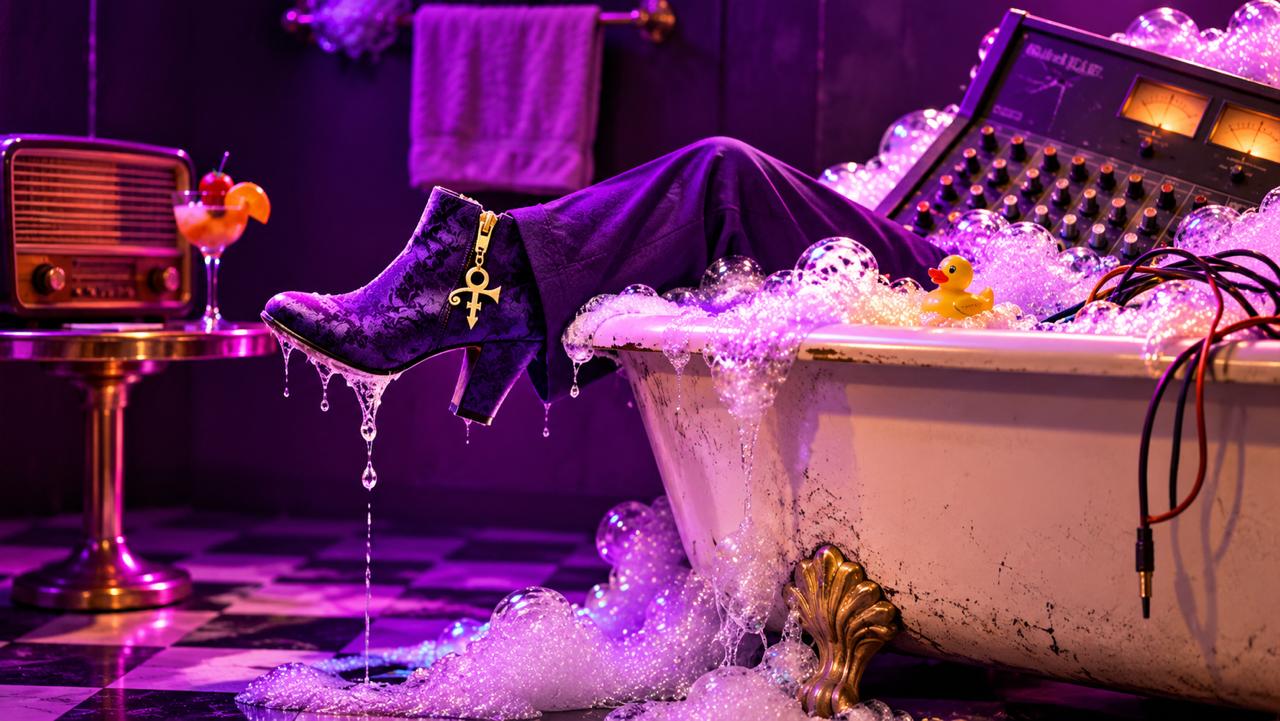
Instead, Prince takes us on a peculiar little journey involving a waitress, a fruit cocktail, a bathtub, a pair of trousers, Joni Mitchell and a relationship that apparently isn't going particularly well.
And somehow, it all makes perfect sense.
Or perhaps it doesn't.
A Waitress, a Fruit Cocktail and an Unexpected Invitation
The story begins with Prince describing a waitress named Dorothy Parker, who works the night shift at a restaurant.
He's apparently had an argument with his lover and needs somewhere to escape.
He finds himself at the restaurant, where he encounters Dorothy, a blonde waitress with a quick wit and an equally quick tongue.
Prince orders a fruit cocktail because he isn't particularly hungry.
So far, nothing especially unusual.
But then Dorothy decides he's rather attractive and asks whether he'd like to take a bath.
Yes, a bath.
Not a drink, not dinner, not a walk along the promenade.
A bath.
And Prince, being Prince, apparently thinks this is a perfectly reasonable suggestion.
There is, however, one condition.
He's keeping his trousers on because he's already involved with someone.
Now, I don't know about you, but if I walked into a restaurant feeling miserable after an argument and the waitress invited me to take a bath, I might have a few questions.
Prince doesn't seem particularly concerned.
And this is where the story starts becoming wonderfully surreal.
Enter Joni Mitchell
Somehow, Prince and Dorothy end up in the bathtub.
Dorothy switches on the radio, and who should be playing but Joni Mitchell.
Specifically, her song Help Me, from the 1974 album Court and Spark.
This isn't a random musical reference.
Prince was an enormous admirer of Joni Mitchell, whose sophisticated songwriting, unusual harmonies and musical independence influenced his own work.
But back to the bathtub.
The telephone rings, Dorothy brushes off the interruption with a flirtatious remark, and Prince seems increasingly captivated by this rather unconventional woman.
Then his trousers get wet.
Naturally, they have to come off.
But just when you might expect the story to develop into a typical Prince sexual encounter, it takes another peculiar turn.
Dorothy apparently refuses to take things further, with Prince describing the situation through a strange metaphor involving a film, a book and a witch's curse that has supposedly left her blind.
At this point, we're well beyond the boundaries of an ordinary romantic song.
And yet, beneath all the absurdity, something rather touching is happening.
Perhaps It Wasn't Really About Sex
What I find interesting is that the encounter doesn't seem to be about seduction.
Prince begins the song upset, frustrated and emotionally exhausted.
Dorothy makes him laugh.
She distracts him from whatever argument he's been having, and her playful behaviour seems to restore his spirits.
Eventually, he returns to his lover.
And what does he do?
He takes another bubble bath, once again with his trousers on.
Apparently, this helps resolve the argument.
The song ends with Prince suggesting that he should have tried this unusual approach sooner.
It's completely ridiculous.
But there's also something rather charming about it.
Instead of solving his relationship problems through a grand romantic gesture, Prince finds comfort in a bizarre encounter with a witty stranger who helps him see things differently.
You could interpret the song as being about emotional connection rather than physical intimacy.
Or perhaps we're reading far too much into something that was never intended to make logical sense.
Because there's a rather extraordinary explanation for why the story is so strange.
Prince apparently dreamed it.
The Dream That Became a Song
According to Susan Rogers, Prince's recording engineer during some of his most creative years, The Ballad of Dorothy Parker was inspired by a dream.
And not just a vague idea that came to him while sleeping.
Rogers recalled that Prince had experienced a vivid dream involving a woman, a waitress and a bathtub.
He woke up and wanted to capture the experience in music before the details disappeared.
In an interview with Wax Poetics, Rogers explained that Prince had recently learned about the writer Dorothy Parker and that his dream somehow combined her with Joni Mitchell.
Think about that for a moment.
A famous American poet from the 1920s, one of the most influential singer-songwriters of the 1970s, a waitress working the night shift and Prince sitting in a bathtub with his trousers on.
All somehow brought together inside Prince's sleeping imagination.
It's the sort of strange combination that makes perfect sense in a dream, only to become almost impossible to explain when you wake up.
And perhaps that's exactly why the song works.
It doesn't follow the rules of conventional storytelling because dreams rarely do.
Characters appear without explanation. Situations change abruptly. Conversations take unexpected turns. And events that would be completely absurd in real life seem perfectly reasonable while they're happening.
Prince didn't try to turn the dream into a conventional love song.
He seems to have embraced its peculiar logic.
The result is something that feels less like a carefully constructed narrative and more like listening to someone recount an unusually vivid dream over breakfast.
But there's another extraordinary twist.
Even the sound of the recording was something of an accident.
A Song That Sounds Like It's Underwater
When Prince decided to record The Ballad of Dorothy Parker in March 1986, his home recording studio had just received a new custom-built mixing console.
The equipment wasn't completely ready.
Susan Rogers was still working through the installation and testing when Prince decided he wanted to record immediately.
He wasn't interested in waiting.
He had a song in his head, and he wanted it on tape.
As recording began, Rogers noticed something was seriously wrong.
The sound was unusually dull and muffled. The higher frequencies were missing, making the entire recording sound almost as though it were happening underwater.
For a recording engineer, this was hardly ideal.
Rogers wanted to stop and investigate the problem.
Prince, however, kept recording.
And recording.
And recording.
By the time they finished, the song had acquired a distinctive, murky sound that was completely different from the bright, polished production heard on many contemporary pop records.
Rogers later discovered that part of the mixing console's power supply wasn't functioning correctly.
The technical fault had affected the sound of the entire recording.
But Prince wasn't particularly bothered.
In fact, he liked what he'd created.
And when you listen to the finished song knowing its origins, the unusual sound almost seems deliberate.
It's hazy, subdued and slightly disconnected from reality.
Exactly the sort of atmosphere you might associate with a dream.
A technical mistake had accidentally given a song inspired by a dream a wonderfully dreamlike sound.
And Prince decided to leave it that way.
So Was Prince Actually Singing About Dorothy Parker?
This brings us back to the question that started my curiosity in the first place.
Was Prince deliberately paying tribute to the famous American writer?
Well, not exactly.
Susan Rogers's recollections suggest that Prince knew of Dorothy Parker and that her name had become mixed up with Joni Mitchell and other imagery in his dream.
But the waitress in the song isn't a biographical portrayal of the real Dorothy Parker.
There's no evidence that Prince was attempting to tell the story of the writer's life.
What is interesting, however, is the personality he gave his fictional Dorothy.
She's witty, outspoken, flirtatious, independent and capable of making Prince laugh when he's feeling miserable.
Those characteristics aren't entirely unlike the reputation of the real Dorothy Parker.
Perhaps Prince was subconsciously drawing on what he'd learned about the writer.
Perhaps he simply liked the name.
Or perhaps the whole thing was just one of those extraordinary combinations that can emerge from a dream.
We may never know precisely how much of the historical Dorothy Parker Prince intended to capture.
But what we do know is that he transformed an unlikely collection of dream images into one of the most unusual and memorable songs on Sign o' the Times.
And nearly forty years later, it's still capable of making someone listening to the album stop and wonder:
Who on earth was Dorothy Parker, and why did Prince give her a ballad?