26 November, 2026
Thursday
FINTECH
I Predicted the Future of Retailing
In 1997, I presented a vision of internet shopping to senior management at a major Australian retailer. They told me it would never take off. Nearly thirty years later, I find myself reflecting on how much retailing has changed, and what we've lost along the way.
Back in 1997
In 1997, I was just 20 years old and completing a retail management traineeship with a major Australian retailer. As part of the program, we were required to complete a final assessment project, which would help determine whether we were offered management positions within the company.
I wanted my project to stand out. Rather than choosing something based on traditional retail management practices, I wanted to explore something dynamic, futuristic and a little different. Something that might actually change the way the industry operated.
My attention had already been drawn to the internet.
At the time, the internet was increasingly making headlines, but here in Sydney, hardly anyone I knew had an internet connection at home. It was still something relatively new and unfamiliar to most people. Those who did have access generally relied on slow dial-up connections through their telephone lines, and simply getting online could be an experience in itself.
The idea of sitting at home, browsing a retailer's website and purchasing products through a computer was almost science fiction to many people.
Yet I was fascinated by the possibilities.
I was particularly interested in how the music industry was beginning to experiment with this new technology. Prince, an artist I'd followed for years, was exploring ways to create an online world where fans could interact with his music. The idea that an artist could use the internet to connect directly with an audience was exciting.
David Bowie was another artist who recognised the potential of the internet early on. He was experimenting with an online presence during the 1990s and went on to launch BowieNet in 1998, creating a dedicated online community for his fans.
BowieNet offered something quite different from the traditional relationship between an artist and their audience. There were news updates, exclusive content and opportunities to connect with Bowie and his music in ways that hadn't previously been possible. There were even live online performances and broadcasts, giving fans a glimpse of a future where the internet could bring artists and audiences closer together.
Bowie wasn't simply using the web to promote his music. He was exploring how it could create an entirely new relationship between artists and their fans. For a glimpse of just how ambitious BowieNet was at the time, this video is worth watching.
As a music fan, I found all of this fascinating. Artists like Prince and Bowie were showing that the internet could become much more than a place to read information. It could be interactive, entertaining and offer entirely new ways of connecting with people.
Of course, the internet was still something of a mystery to much of the population. Even The Simpsons was making fun of it. In a 1998 episode, Homer Simpson decides to start an internet business after discovering that his neighbour Ned Flanders is making money online. When Homer enthusiastically tells Marge about his new venture, her response is simply, "Internet, eh?"
It was a wonderfully funny reflection of the times. The internet was attracting enormous attention, but plenty of people still weren't entirely sure what it was, how it worked or why they would ever need it.
Looking back, it makes my 1997 retail management project seem even more ambitious. While the internet was still something people were trying to understand, I was already imagining a future where customers could browse a department store and purchase products from their computers.
And that's when I decided to explore the future of retailing.
Building an Online Store Before Online Shopping Was Normal
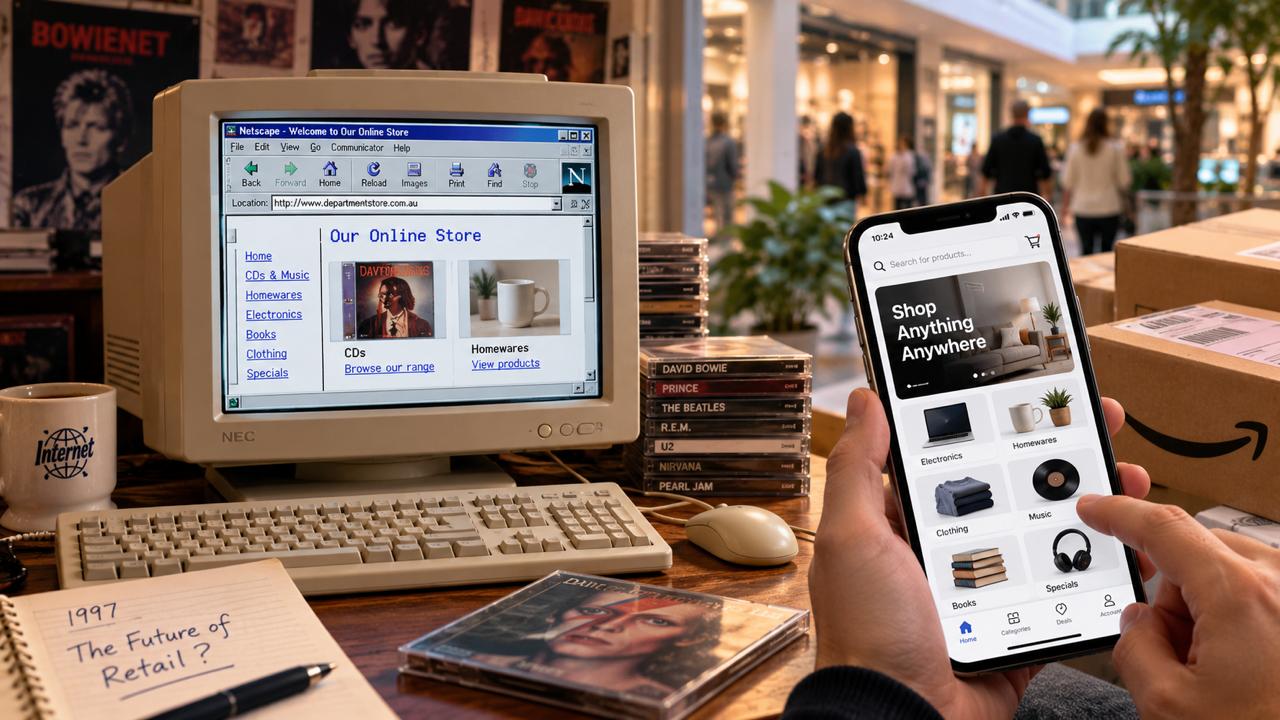
For my final project, I created a mock-up internet shopping website showing how the retailer I worked for could eventually sell its products online.
I built it using basic Microsoft Word documents, converting them into web pages. By today's standards, it was incredibly primitive, but in 1997, simply creating a website was still something relatively new.
The concept was straightforward. Customers would be able to visit the retailer's website, browse products and make purchases without physically visiting a store.
I demonstrated how customers could purchase CDs online, including the ability to preview music before making a decision. I also included basic homewares, showing how a traditional retailer might present its merchandise to customers through a computer screen.
Looking back, the music component is particularly interesting. Today, previewing music online is something we barely think about. But in 1997, the idea of listening to a sample of an album through a retailer's website before buying the CD was still quite futuristic.
I wasn't suggesting that physical shops would disappear overnight. I was demonstrating how the internet could offer retailers an entirely new way to reach customers.
At the time, it was largely American businesses that were attracting attention for experimenting with online commerce. Amazon had launched its online bookstore in 1995, and eBay had also emerged that year. In Australia, online retailing was still in its infancy.
I could see the possibilities, though, and I wanted to show what the future might look like.
Then Came the Big 'But'
Senior management from the retailer attended our final presentations. These were experienced people who understood the retail industry, and I was presenting an idea that challenged some of its most established assumptions.
Initially, the feedback was encouraging. The managers complimented me on the project. They thought it was well presented, interesting and a good piece of work.
But then came the big but.
They simply couldn't see internet retailing becoming successful.
People would always want to see, touch, feel and even smell the products they were buying, I was told. Shopping was a physical experience, and customers weren't going to abandon that in favour of purchasing things through a computer.
I also remember being told that a few retailers had already experimented with online sales, but the concept hadn't really taken off. It was expensive, the technology was complicated, and the commercial potential simply wasn't convincing.
To them, it was almost like something out of The Jetsons. A futuristic idea that might look interesting in a presentation but wasn't likely to become part of everyday life.
I had deliberately chosen something forward-looking, so the reaction was memorable. Nevertheless, the project itself was successful, and I went on to secure a management position with the retailer.
The executives might not have believed in my vision of internet shopping, but thankfully, that didn't prevent me from progressing in my career.
My First Online Purchase
I still remember my first purchase over the internet.
Perhaps unsurprisingly, it was a CD, ordered from the United States.
There was something exciting about being able to find and purchase music from another country without having to visit a record shop. But the delivery experience was another matter entirely.
It was a long, drawn-out wait for the CD to arrive.
In some ways, it reminded me of ordering records through the mail-order clubs advertised in magazines. You'd fill out an order form, send a cheque through the post and then wait patiently for your music to turn up.
The internet had changed the ordering process, but the delivery experience hadn't quite caught up.
Today, we're accustomed to tracking parcels, receiving delivery notifications and sometimes having purchases arrive the following day. Back then, the entire process required a little more patience and a fair amount of trust.
Yet the potential was obvious to me.
When the Small Guys Could Compete with the Big Guys
I continued working in retail management for many years after that presentation, but my interest in the internet never disappeared.
Eventually, I established my own internet-based businesses, selling computer-related products and providing internet services.
Looking back, there's something satisfying about that progression. At 20, I'd stood in front of senior retail executives demonstrating how the internet might transform shopping. Years later, I found myself operating businesses using the very technology I'd been so enthusiastic about.
One of the most fascinating developments was how the internet began changing the relationship between small businesses and major retailers.
Traditional retailing was dominated by businesses with established store networks, substantial buying power, advertising budgets and the financial resources to secure prominent locations. Competing with a major department store was no small undertaking.
The internet changed some of those rules.
A small business could create a website and suddenly reach customers well beyond its immediate neighbourhood. It could specialise in products that larger retailers overlooked, operate without an expensive network of physical stores and potentially attract customers from across Australia or even overseas.
Of course, running an online business wasn't free or easy. You still needed products, suppliers, marketing, customer service and a way to fulfil orders. But the opportunity to reach a much larger audience without opening more shops was revolutionary.
For the first time, a small retailer could compete for customers in ways that would have been extraordinarily difficult under the traditional model.
And that was one of the changes I found most exciting.
The Slow Rise of Online Shopping
Although I could see the potential in 1997, the retail industry didn't transform overnight.
From my perspective, it took another solid decade before online retailing began to be widely recognised as both a genuine commercial opportunity and a potential threat to traditional stores.
Internet access became more common, connections became faster, websites improved and consumers gradually became more comfortable entering payment details online.
Retailers began investing more seriously in their websites, and customers discovered the convenience of being able to shop without leaving home.
Then smartphones made the internet something we carried around in our pockets.
Suddenly, shopping wasn't something that required sitting down at a desktop computer. You could browse products on the train, compare prices while standing inside a shop or make a purchase while watching television.
The barriers that had seemed so significant in 1997 were gradually disappearing.
And then came COVID.
COVID Changed Our Shopping Habits
The COVID pandemic didn't create online shopping, but it gave the industry an enormous push.
With lockdowns, restrictions and people spending extended periods at home, online shopping became a necessity for many consumers rather than simply a convenient alternative.
People who had previously been reluctant to shop online suddenly found themselves ordering groceries, clothing, electronics, homewares and all sorts of other products through websites.
And with so much time being spent at home, browsing online stores also became a form of entertainment.
When restrictions eventually lifted, many of those habits remained.
We had become accustomed to the convenience of ordering something whenever we wanted and having it delivered to our door.
Retailers had also adapted. Their online operations had become more important, distribution networks had expanded, and the relationship between physical stores and online warehouses was changing.
The internet had become an essential part of retailing.
Nearly thirty years after my presentation, the idea that people wouldn't embrace online shopping seems almost impossible to imagine.
But something else happened along the way.
Something I hadn't really considered back in 1997.
When Shopping Was a Day Out
For all the convenience online shopping has brought us, I do think we've lost something.
Shopping used to be an experience in itself.
A day out shopping wasn't necessarily about needing to buy something. It was about getting out of the house, wandering through a shopping centre, browsing different stores, stopping for coffee or lunch and enjoying a few hours away from everything else.
It was social. It was entertainment. It was time out.
You could spend an entire Saturday afternoon looking through shops without any particular agenda. Sometimes you'd discover something you hadn't even known you wanted.
I particularly miss record shops.
I could spend hours flicking through the racks, looking at album covers, discovering artists and exploring music I hadn't heard before. There was always something playing over the shop's sound system, and that was part of the entertainment.
Sometimes the music playing in the store would catch your attention, and you'd find yourself asking what it was. Other times, an interesting album cover was enough to make you curious.
Record shops had their own culture. They weren't simply places where you purchased music. They were places where you discovered it.
Of course, the internet would eventually transform the music industry just as dramatically as it transformed retailing. Digital downloads began replacing physical purchases, and then streaming services changed everything again. Why buy a CD when you could have access to millions of songs through your phone?
CD sales declined dramatically, and countless record shops disappeared. The convenience of digital music had taken away much of the reason people visited them in the first place.
But something interesting has been happening in recent years.
Vinyl records have made a remarkable comeback, and CDs are also attracting renewed interest, particularly among collectors and younger music fans discovering physical formats for the first time. Independent record shops have found new audiences, and events such as Record Store Day have helped bring attention back to the experience of buying music in person.
For some people, it's nostalgia. For others, particularly younger generations who grew up with streaming, there's something exciting about actually owning an album, holding the artwork, reading the sleeve notes and building a physical collection.
Perhaps it's a reaction to a world where so much of what we consume exists only as a digital file or a subscription.
I find that particularly interesting because it suggests that convenience isn't always everything. Sometimes people still want the experience, the connection and the sense of ownership that comes with something physical.
Streaming has given us access to an extraordinary amount of music, but it hasn't completely replaced the experience of walking into a record shop and discovering something unexpected.
And perhaps there's a lesson in that for the wider retail industry.
I also miss the variety that large shopping centres once seemed to offer, particularly when it comes to clothing.
There are still plenty of stores, but I don't feel the selection within them is as extensive as it used to be. You can spend hours wandering through a shopping centre and still struggle to find something you like in your size.
And even when you do find something, there's often that familiar response from the sales assistant.
We can order it for you online.
I've actually found myself standing inside a clothing store, ordering something from that very retailer's website because the physical shop didn't have my size.
There's something rather ridiculous about that.
I've made the effort to go shopping, found something I want to buy, and then ended up doing exactly what I could have done sitting at home.
These days, most of my in-person shopping is for groceries, largely because I want those products immediately. For almost everything else, ordering online is simply easier.
But I do miss the pleasure of going shopping just for the experience.
And that's perhaps the greatest irony of my prediction.
I was right about the convenience of internet retailing, but I never really considered how much I might eventually miss the traditional shopping experience.
The Store of the Future Might Be a Showroom
So, having watched retailing transform over almost thirty years, what do I think comes next?
I suspect we're going to see another significant change in the role of physical stores.
My prediction is that major retailers will continue reducing the number and size of their traditional stores, much like the banking industry has done with its physical branches.
Some retailers may eventually operate only a handful of major flagship locations, while others with larger networks could increasingly transform their existing stores into showrooms.
Instead of carrying extensive quantities of stock in every size, colour and variation, stores could concentrate on displaying products so customers can see, touch, try and experience them.
Once you've decided what you want, you place an order, and the product is dispatched directly to your home from a central warehouse.
In many ways, furniture retailers have operated like this for decades.
You visit a showroom, choose a lounge suite or dining table, select the colour or configuration you want and arrange delivery. You don't necessarily expect to take the furniture home with you that afternoon.
I can imagine that model becoming increasingly common across other retail categories.
There are obvious advantages for retailers. They may be able to reduce the amount of stock held across multiple locations, centralise inventory management and offer customers a much wider range than any individual shop could physically accommodate.
But I also wonder what that will mean for the shopping experience.
If a store becomes primarily somewhere to look at products before ordering them online, will customers still want to spend an afternoon browsing?
And if you can't take home the things you discover, does shopping lose some of its spontaneity?
Perhaps retailers will eventually realise that physical stores need to offer something more than simply being another place to complete a transaction. They may need to become destinations again, places that offer an experience worth leaving home for.
Nearly Thirty Years Later
I sometimes have a quiet giggle when I think about that final assessment project from 1997.
I was 20 years old, using basic Word documents to create a mock-up shopping website, demonstrating how customers might one day purchase CDs and homewares through the internet.
The website itself would look incredibly dated today. Unfortunately, I didn't keep the original project, although I remember the idea behind it clearly.
I also remember the senior managers who complimented the presentation but couldn't imagine internet shopping becoming a commercial success.
To be fair, their concerns weren't entirely unreasonable at the time. Internet connections were slow, online payment systems were still developing, delivery could be expensive and many customers were understandably cautious.
What they underestimated was how dramatically technology, convenience and consumer behaviour would evolve.
I certainly didn't predict every development that followed. I couldn't have imagined the sophistication of today's smartphones, the scale of global online marketplaces or the enormous influence of social media on purchasing decisions.
But I did recognise that the internet would fundamentally change how people shopped.
And it did.
Now, almost thirty years later, I'm making another prediction about the future of physical stores. Perhaps in another thirty years, I'll look back and have another quiet giggle about that one too.
But there's one thing I find myself reflecting on more than anything else.
In 1997, I predicted a future where we wouldn't have to go shopping. What I didn't predict was a future where I'd miss going shopping.