07 Oct 2026
12 October, 2026
Monday
I caught up with a friend recently who I hadn't seen for some time. She's going through one of those periods where seemingly everything in life is changing at once. She's dealing with a challenging divorce, leaving the family business and preparing to go out and work on her own.
We spent quite a while comparing notes about life, difficult changes and what happens when circumstances force you to rethink where you're going. Somewhere in that conversation I asked her a question that probably seemed completely unrelated.
"Have you done anything with AI yet?"
She hadn't. It wasn't something she'd taken much interest in.
My response was fairly simple. Don't reject it. Embrace it. Start somewhere and grow from there.
I wasn't suggesting she needed to become an AI expert, learn how a large language model works or suddenly restructure her life around ChatGPT. My point was that I think we're living through one of those pivotal moments when a new technology changes how we work and, eventually, how we live.
The conversation got me thinking about how many times we've been here before.
I have another friend who tells a story that seems almost unbelievable today. When he was young, he decided to leave school before finishing his HSC because he wanted to start a computer business.
One of his teachers tried to talk him out of it. His advice was essentially, "This computer thing is a fad. It won't last. Eventually people will stop using them."
There was just one problem with that advice. My friend was already selling and maintaining computers and, even at that young age, was making more money doing it than the teacher who was telling him computers had no future.
I sometimes wonder where that teacher is now.
It's easy to laugh at the prediction today, but perhaps we shouldn't. Predicting the future is remarkably easy when you're looking backwards. At the time, personal computers were expensive, relatively primitive and completely unnecessary for most households. You could quite reasonably live and work without ever touching one.
That didn't last for long.
Computers moved into offices. Typewriters disappeared. Filing cabinets gave way to databases. Bookkeeping became software. Letters became documents created on a screen. Entire administrative processes that once required teams of people could increasingly be performed by fewer people using computers.
Some jobs disappeared or changed dramatically, while completely new industries and occupations were created. But another important division emerged in the workplace. People who knew how to use computers could suddenly do things that people without those skills couldn't.
There was even a period when people proudly listed "computer literate" on their résumés. Today that would sound almost as strange as listing "can use a telephone."
Knowing how to use a computer stopped being an advantage. It became an expectation.
The next great shift was the internet, and I remember having conversations about this one myself.
Back in the 1990s, during my retail days, I completed retail management training and we spent some time discussing what the future of retail might look like. One of the ideas being talked about was shopping over the internet.
I remember suggesting that online shopping was going to become a big thing. The reaction from others was basically, "No, you're crazy. That will never take off."
The argument actually sounded quite reasonable at the time. People wanted to go into a shop. They wanted to see what they were buying, pick it up, touch it, feel it and perhaps try it on. Why would someone buy something from a computer screen when they could walk into a store and look at the real thing?
There was also the question of trust. Would people really type their credit card details into a computer and send them somewhere over this new thing called the internet? Would they buy something they hadn't physically seen and then wait for someone to deliver it?
The whole idea sounded a little too futuristic.
"We're not going to be living like The Jetsons."
Except, eventually, we were.
It certainly didn't happen overnight. Physical stores didn't suddenly disappear and online shopping took years to develop. Internet connections improved, websites became easier to use, online payments became more trusted and delivery networks became better. Gradually, buying something online stopped feeling unusual.
Then circumstances gave the transition an enormous push.
COVID arrived.
Suddenly millions of people who might previously have preferred walking into a store had a very good reason not to. Businesses that had treated online retail as something secondary suddenly needed it. Consumers who had resisted buying certain things online tried it because they had little choice, and many discovered that it was actually quite convenient.
The pandemic didn't create online shopping. By 2020 it was already a huge industry. But COVID dramatically accelerated a change that had been developing for decades.
Today I can sit on my couch, order groceries, clothes, electronics or almost anything else, pay for it without touching cash and have it delivered to my door. Sometimes it can arrive the same day.
Perhaps The Jetsons wasn't such a ridiculous comparison after all.
And retail was only one part of what the internet changed. Email became normal. Search engines replaced directories and encyclopaedias. Banking moved online. Newspapers, music, travel, advertising, dating, recruitment and countless other industries were transformed. Entire businesses appeared that simply could not have existed before the internet.
Once again, the technology moved through stages. At first it was something interesting that some people were experimenting with. Then knowing how to use it became an advantage. Eventually, not knowing how to use it became a disadvantage.
Nobody asks at a job interview today whether you're an "internet person". You just use it.
I saw the same thing happen again with smartphones, this time much closer to home.
I had a family member who simply didn't want one. They were perfectly happy with the classic Nokia-style mobile phone. It made calls, had a send button and an end button, and if necessary they could send an SMS. That was all they wanted from a phone, and for quite a while they could get away with it.
I could understand the argument. They already had a computer for the internet, so why did they need a smartphone as well? If all they wanted to do while away from home was make a telephone call, their old phone did the job perfectly well.
The problem was that the world didn't stand still.
Banking increasingly required mobile authorisation. Websites started sending one-time passwords to mobile phones or asking you to approve a login through an app. Tickets, maps, transport, parking and countless other everyday services gradually moved onto smartphones.
Then COVID came along and accelerated things again.
Suddenly we were being asked to scan QR codes and check in when entering shops, restaurants and other venues for contact tracing. Something that had previously been a personal choice became considerably harder to avoid. If you didn't have a smartphone, you increasingly found yourself relying on someone else or looking for an alternative way of doing something that everyone around you could complete in seconds.
Eventually my family member had to catch up.
But while they were learning how to use a smartphone, download apps, scan QR codes and navigate things the rest of us had gradually learnt over years, we were already comfortable with it. We'd learnt each little change as it arrived. They were suddenly having to learn everything at once.
I think that's an important part of being left behind by technology that we sometimes overlook. You can refuse a new technology for years and be perfectly fine. The problem comes when circumstances eventually force you to adopt it and you discover that everyone else has had a ten-year head start.
Today, try functioning without a smartphone.
You can own a perfectly good computer and have a fast internet connection, but that still isn't enough for many things. Your bank may require its mobile app to authorise a transaction. A website may require your phone to verify your identity. Your airline puts your boarding pass in a digital wallet. Restaurants use QR codes for menus and ordering. Parking can require an app. Maps tell us where we're going and ride-sharing apps get us home.
And for someone like me who goes to a lot of concerts, there's another very obvious example. My concert tickets are increasingly stored in the digital wallet on my phone. Sometimes there isn't even a practical printed ticket anymore. That phone in my pocket is quite literally my way through the door.
Even while sitting in front of a computer, I regularly have to pick up my smartphone to approve what I'm doing on that computer.
The smartphone didn't simply give us another way of accessing the internet. It gradually became a key to participating in the modern world.
My family member wasn't wrong because they preferred their old Nokia. It did exactly what they wanted it to do, and for years there was no compelling reason for them to change.
The problem was that while everyone else was gradually learning how to use smartphones and adapting as each new service arrived, they were standing still. Eventually circumstances forced them to make the change, but by then they had years of catching up to do.
That's the risk with ignoring a major technological shift. You can keep doing things the old way for quite a long time, but eventually you may find yourself having to catch up while everyone else has already moved ahead.
There's another example of this that I often think about. The stereotypical little old lady who has always walked into her local bank branch carrying her passbook.
For decades, that was how she did her banking. She knew the staff at the branch, deposited or withdrew her money over the counter and had the transaction recorded in her book. She didn't need internet banking or a mobile app because the system she had always used worked perfectly well.
Then the world changed around her.
Banks encouraged customers to move to internet banking. Mobile banking apps arrived. Transactions that once required a visit to a branch could be completed in seconds from home. Then bank branches started closing, and many of the branches that remained reduced their services.
Suddenly our little old lady has a problem. She hasn't necessarily done anything wrong. The way she has always banked still makes perfect sense to her, but while everyone else has gradually learnt internet banking and mobile banking, she hasn't.
The bank wants her online. It wants her using the app. It wants transactions completed digitally rather than by someone standing at a counter. Increasingly, the bank doesn't particularly want to see her at all.
Now she's being forced to catch up, except she's trying to learn everything at once. Passwords, PINs, internet banking, banking apps, authentication codes and perhaps even how to use the smartphone itself.
That's what being left behind by technology can actually look like.
It doesn't necessarily happen because your old way suddenly stops working one morning. It happens gradually. You keep doing things the way you've always done them while everyone else slowly learns the new way.
Then one day you discover that catching up is much harder than keeping up would have been.
And that brings me back to AI.
We aren't waiting for the AI revolution to arrive.
We're already living through it.
There is plenty of hype surrounding artificial intelligence, and some of it deserves to be treated with scepticism. Every major new technology attracts exaggerated predictions, questionable businesses and people announcing that everything we've ever known is about to disappear.
AI also makes mistakes. It can confidently give you completely wrong information. It requires human judgement, checking and common sense. There are things I would never simply hand over to AI and trust without verification.
But dismissing AI because it isn't perfect misses what's already happening.
I don't think the most useful question is whether AI is going to take your job. The more immediate question might be whether somebody doing the same job as you, who knows how to use AI effectively, will be able to do considerably more than you can.
That's where I think the real change is happening.
One person might spend several hours researching a subject and organising the information. Someone else can use AI to help gather and structure that information, then spend their time checking it and deciding what matters.
Someone might stare at a blank page for an hour trying to work out how to structure a proposal. Someone else can use AI to develop an initial structure, challenge the assumptions behind it and then apply their own experience to turn it into something useful.
A small business owner can use AI to analyse ideas, draft correspondence, interrogate a spreadsheet, create procedures, research competitors, brainstorm marketing ideas or simply ask, "What am I forgetting?"
The human hasn't disappeared from any of those examples. The human has become more productive.
This was really what I was trying to tell my friend.
She's preparing to go out on her own, and that means there will suddenly be a lot of things she needs to think about. She doesn't need to understand neural networks, machine learning, APIs or how a large language model predicts the next word.
She just needs to start using it.
She could begin with something as simple as: "I'm leaving a family business and preparing to work independently. Help me create a checklist of everything I should think about."
Then ask another question: "Challenge that list. What have I forgotten?"
Later she might use it to help draft an introductory email to potential clients, think through pricing, organise a business plan or calculate how many clients she needs each month to cover her costs.
That's how you learn AI. Not necessarily by studying it, but by finding something useful to do with it.
The more you use it, the more you begin to understand what it's good at. Just as importantly, you start discovering what it's bad at and when you shouldn't trust it.
There's a pattern running through all of this.
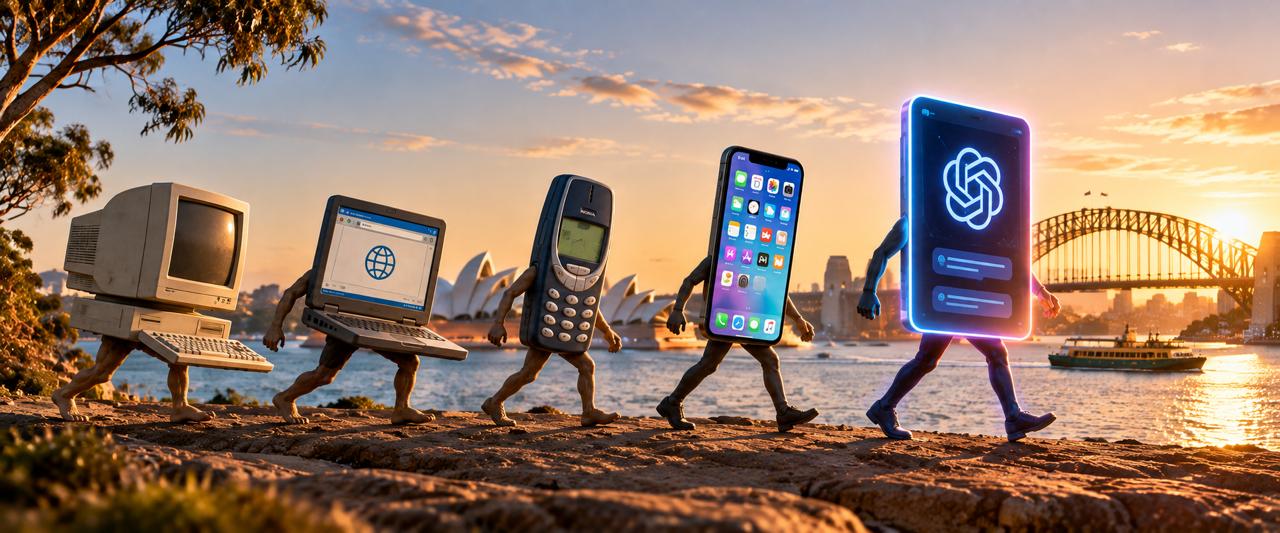
The personal computer began as something most people didn't need. Then it became useful. Eventually, computer skills became expected.
The internet began as something many people struggled to see the point of. Then it became useful. Eventually, being connected became almost unavoidable.
The smartphone started as an expensive gadget that duplicated things we could already do. Then apps and services gradually made it increasingly difficult to function efficiently without one.
AI isn't exactly the same as any of these technologies, and history doesn't guarantee that every new technology succeeds. Plenty don't. But AI has already demonstrated enough practical usefulness that ignoring it completely is becoming a risk of its own.
There will probably come a point when saying "I use AI at work" sounds just as strange as saying "I use the internet at work."
Of course you do.
Twenty years from now, we may look back at today's debate about whether we should "use AI" and find the question slightly ridiculous.
Nobody asks whether they should use computers anymore. Nobody seriously debates whether their business should use the internet. Most of us couldn't comfortably get through a week without our smartphones.
AI may eventually become just as invisible. It may simply become another layer of the technology we use every day without giving much thought to what sits underneath it.
That doesn't mean blindly embracing every AI product that appears. It doesn't mean trusting everything AI tells you, and it certainly doesn't mean replacing human judgement with whatever appears on a screen.
It means learning enough to understand what the technology can do for you.
You don't need to become an expert today. You don't need to understand how it all works. Just don't stand still. Start somewhere, learn something and grow from there.
Because the worst time to start learning about a pivotal technology is when everyone around you already assumes you know how to use it.
Perhaps that's the real lesson from the computer, the internet and the smartphone. You don't have to be the first person to embrace every new technology.
But it's much easier to keep up than it is to catch up.