07 Oct 2026
12 October, 2026
Monday
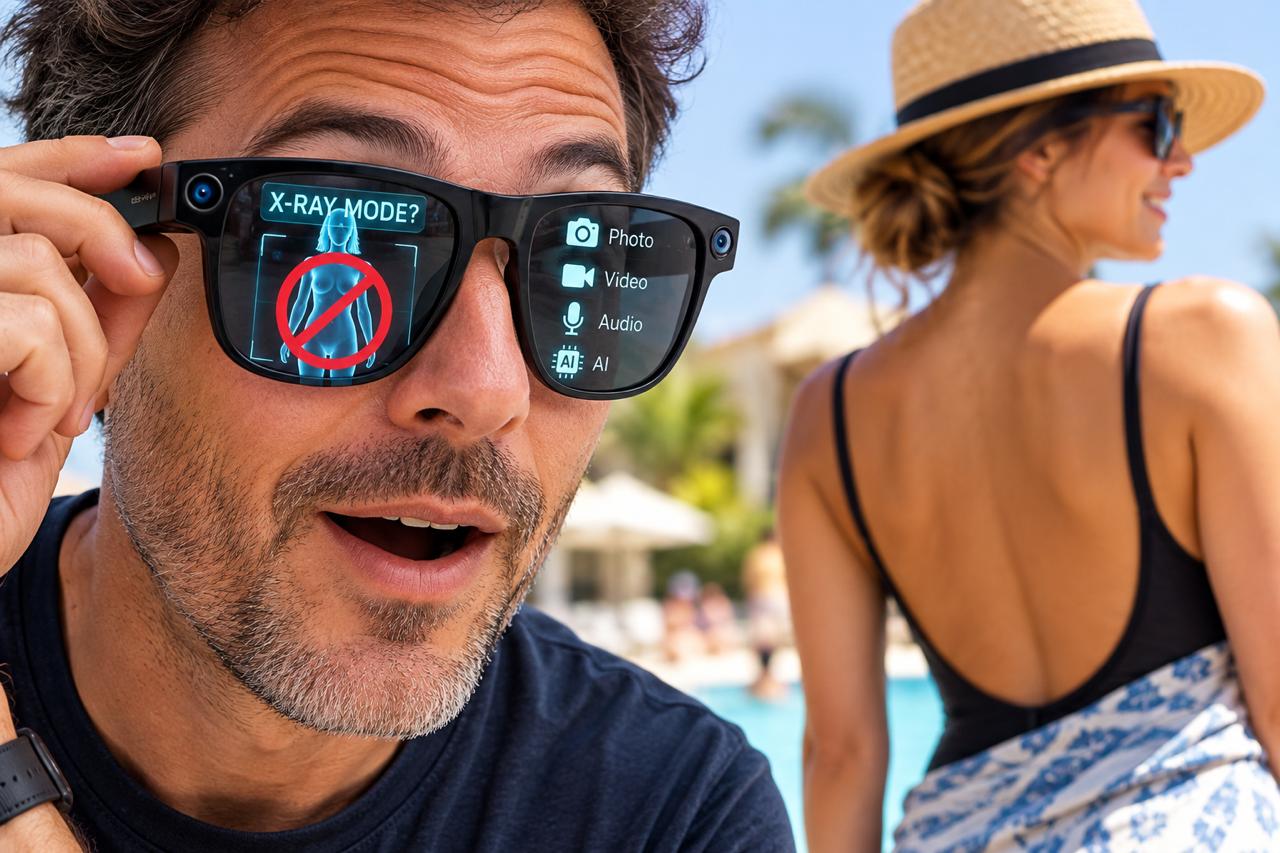
Let's get the most important question out of the way first.
No. The person sitting opposite you wearing a pair of smart glasses cannot see you naked.
Despite what decades of comic books, spy movies and those old advertisements for "X-ray glasses" might have promised us, today's consumer smart glasses cannot see through your clothing.
So if somebody wearing a pair of Ray-Bans looks in your direction, there's no need to immediately cover yourself.
What those glasses might be capable of doing, however, could give you considerably more reason to think about your privacy.
They may be able to photograph you, record video of you, hear your conversation, interact with artificial intelligence and analyse what the wearer is looking at.
And increasingly, they don't look particularly "smart" at all.
They just look like glasses.
"Smart glasses" is actually a broad term covering several different types of wearable technology.
At the simplest end are glasses with built-in speakers and microphones. They essentially work like wireless earbuds built into a pair of glasses, allowing you to listen to music, make telephone calls or talk to a voice assistant.
Then there are camera glasses. These contain tiny cameras that can take photographs and record video from approximately the same perspective as the person wearing them.
More sophisticated models combine cameras, microphones, speakers and artificial intelligence. The wearer can look at something and ask the AI questions about what they're seeing.
Another category adds a display to the lenses, placing information directly into the wearer's field of vision. Depending on the device, this might include navigation instructions, translations, notifications, captions or text.
And then there are augmented-reality glasses that can place much larger virtual screens and objects into the world around you.
What sounded like science fiction only a few years ago is rapidly becoming an ordinary consumer product.
Capabilities vary considerably between models, but smart glasses available today can potentially:
That last point is important.
Smart glasses aren't inherently sinister technology. There are potentially enormous benefits.
AI-enabled glasses can, for example, help someone with impaired vision identify an object in front of them, read a sign or label, or understand something about their surroundings without needing another person to assist them.
There are also obvious uses for navigation, travel, education, work, sport and communication.
The problem isn't necessarily what smart glasses are.
It's that we're putting increasingly powerful cameras, microphones and computers into something society has always regarded as completely ordinary.
A pair of glasses.
Perhaps the easiest way to understand how far the technology has progressed is simply to look at some of the products already available.
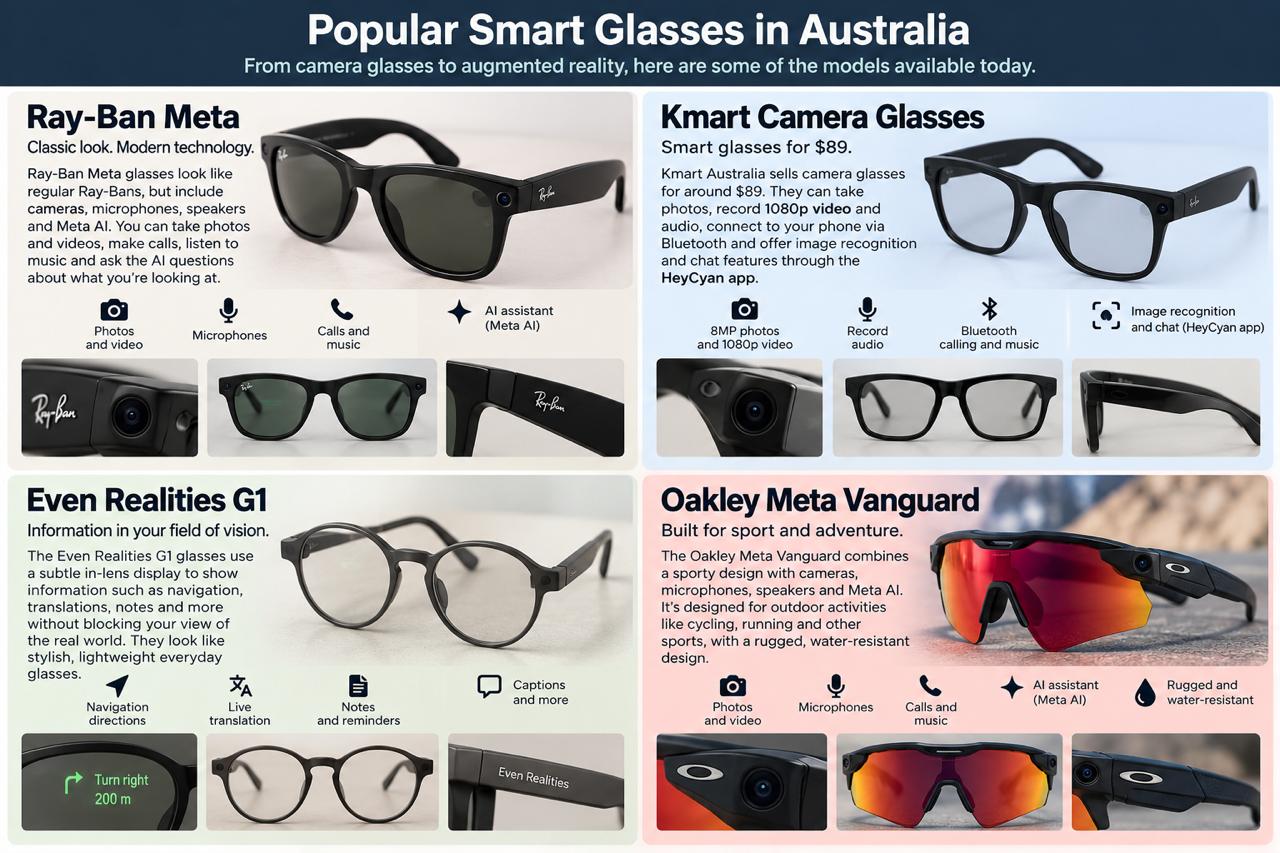
The comparison above shows just how varied the category has become.
Ray-Ban Meta is probably the best-known example. It combines the familiar Ray-Ban appearance with cameras, microphones, speakers and Meta AI. From a distance, you could quite easily mistake them for ordinary Ray-Bans.
Kmart Camera Glasses demonstrate how accessible this technology has become. For around $89, Australian shoppers can buy glasses capable of taking photographs, recording 1080p video and audio, making Bluetooth calls and connecting to a companion app.
Even Realities G1 takes a different approach. Information can be displayed within the wearer's field of vision, including navigation, translations, notes and other information, while the glasses themselves retain a relatively conventional appearance.
Oakley Meta Vanguard takes smart glasses into sport and fitness, combining a sportier design with cameras, microphones, speakers and AI functionality.
Looking at these products demonstrates one of the biggest privacy challenges.
They don't necessarily look like computers.
This is where smart glasses stop being some futuristic gadget only technology enthusiasts are likely to own.
You can walk into Kmart.
Kmart Australia currently sells Camera Glasses for around $89.
They include an 8-megapixel camera, can record 1080p video and audio, connect to a smartphone and provide Bluetooth calling and audio functionality. They also connect with a companion application offering image-recognition and chat features.
Kmart itself warns customers that the product is capable of capturing images, video and audio and reminds users that privacy, surveillance, recording and consent laws may apply.
That warning is significant.
If smart glasses cost thousands of dollars and were worn by a handful of technology enthusiasts, the privacy issue would remain relatively niche.
When camera glasses are available from one of Australia's largest discount retailers for less than $100, the conversation changes.
No.
Sorry to disappoint anyone who clicked on this article solely hoping that technology had finally delivered the X-ray glasses promised in the back pages of comic books.
Normal consumer smart glasses cannot see through clothing.
They cannot see through walls either.
And despite the enormous advances in artificial intelligence, AI cannot magically reconstruct an accurate naked image of the person standing in front of you simply because you're wearing smart glasses.
Specialised thermal imaging and night-vision technologies obviously exist, but that's something quite different from the ordinary consumer smart glasses we're discussing here.
The much more interesting questions are what these glasses can see.
Potentially, yes.
If the glasses contain a camera, the wearer can take photographs or record video without holding a phone in front of them.
Some manufacturers incorporate recording indicators designed to alert people nearby when recording is occurring.
But there's a fundamental social difference between a smartphone and glasses.
When somebody raises an iPhone and points it towards you, you generally recognise what's happening.
When somebody wearing glasses looks at you, you assume they're simply looking at you.
We've spent our entire lives making that assumption.
Smart glasses challenge it.
This one is more complicated.
Mainstream smart glasses such as Ray-Ban Meta do not simply walk around automatically identifying every stranger the wearer looks at.
But all the technological ingredients required to do something remarkably similar already exist.
The glasses have a camera.
Artificial intelligence can analyse images.
Facial-recognition systems can match faces against databases and publicly available photographs.
Researchers have already demonstrated what happens when these technologies are connected.
In 2024, two Harvard students created a proof-of-concept system called I-XRAY using Ray-Ban Meta glasses. Their demonstration combined the glasses' camera with facial-recognition and online search technologies to identify strangers and retrieve publicly available information about them.
It wasn't an official Meta feature.
But it demonstrated something important.
The question is increasingly becoming not whether smart glasses are technically capable of helping identify the person standing in front of you, but whether manufacturers and software developers will permit that functionality.
Meta has also reportedly experimented with facial-identification capabilities for its glasses.
Imagine meeting someone at a party for the first time.
You look at them.
Your glasses recognise their face.
Their name appears.
Potentially, information gathered from the internet or social networks appears alongside it.
That's no longer particularly difficult science fiction to imagine.
And now we return to our naked people.
Not because the glasses can see through your swimsuit.
Because they may contain a camera.
Public swimming pools present a particularly obvious privacy problem. Adults and children are walking around in swimwear. There are changing facilities and showers nearby, and people understandably have different expectations of privacy in these environments.
Australia is already beginning to respond.
One Australian council has introduced restrictions targeting the use of smart glasses to covertly photograph or record people at public swimming pools.
The important distinction is that the issue isn't necessarily someone simply wearing smart glasses.
There are legitimate reasons why someone might wear them, including accessibility or prescription requirements.
The concern is using camera-equipped glasses to covertly record other people without their knowledge.
Other Australian governments and institutions are also considering how smart glasses should be treated in schools, workplaces and other environments.
It raises an interesting regulatory problem.
We already know how to deal with cameras in sensitive places.
But what happens when the camera doesn't look like a camera?
There's another side to this story that is surprisingly easy to overlook.
We've been worrying about the person wearing the smart glasses spying on everyone else.
Perhaps the person wearing them should be worried too.
Recent Australian testing of inexpensive smart glasses identified serious security weaknesses in some devices.
ABC reported in September 2026 that independent security testing of inexpensive smart glasses sold in Australia uncovered vulnerabilities that could potentially allow someone nearby to gain access to photographs and videos stored on certain glasses.
That introduces an entirely different privacy question.
Smart glasses potentially collect enormous amounts of information about the wearer's life.
Think about what your glasses might see during an ordinary day.
Your computer screen.
Your PIN number.
Documents sitting on your desk.
Your children.
Your home.
People you meet.
Where you go.
Conversations you have.
If that information is stored insecurely or transmitted to poorly secured applications or cloud services, the person wearing the glasses could potentially become the privacy victim.
As with many Internet-connected devices, cheap hardware can sometimes come with cheap security.
Yes.
And that's probably the strongest argument against panicking about smart glasses.
Your smartphone already contains multiple cameras, microphones, GPS, internet access, artificial intelligence and an extraordinary amount of personal information.
But there's one major difference.
We recognise a phone as a recording device.
Society has developed an informal language around smartphones.
If somebody holds a phone up at a concert, they're probably recording.
If somebody points their phone directly towards you, you notice.
If somebody walks into a change room holding their phone in front of them, people may become suspicious.
Glasses don't generate the same reaction.
Someone can simply look at you.
That's what makes this technology socially different.
Some camera-equipped smart glasses include an external light intended to indicate that recording is taking place.
That's certainly better than having no indication at all.
But ask yourself a simple question.
If someone sitting three metres away from you was wearing smart glasses, would you know what a tiny white light on the corner of their frames meant?
Would you even notice it?
As smart glasses become more common, perhaps we'll learn to recognise these signals in exactly the same way we've learned to recognise somebody pointing a smartphone camera.
Right now, most people probably wouldn't.
Despite the privacy concerns, I don't think the answer is simply banning smart glasses.
The technology has too many legitimate and potentially valuable uses.
For someone with impaired vision, they could provide considerably more independence.
For a traveller, instant translation could be incredibly useful.
For navigation, having directions appear without constantly looking down at a phone makes obvious sense.
For photographers, athletes, workers and countless other users, having a hands-free computer that sees roughly what they see could be genuinely transformative.
And as the technology improves, the glasses themselves will become less conspicuous.
That's probably inevitable.
The challenge will be establishing social rules around them before they become completely ordinary.
So no.
The man wearing Ray-Bans beside the swimming pool cannot see through your Speedos.
But he might be wearing a camera.
And increasingly, that camera may be connected to an artificial intelligence capable of understanding what it's looking at.
Eventually it may recognise faces, remember information, translate conversations and provide the wearer with information about the world around them in real time.
At the same time, those glasses may themselves be collecting an extraordinary record of the wearer's life.
For more than a century, we've been able to make one very safe assumption when talking to someone wearing glasses.
They're simply looking at us.
Smart glasses quietly change that social contract.
Perhaps the real question isn't whether smart glasses will ever be able to see us naked.
It's whether we're comfortable living in a world where the glasses people wear can see, hear and remember almost everything they can.
Since publishing this article, there has been a significant development in Australia.
Kmart has removed its $89 Anko camera-equipped smart glasses from sale amid mounting privacy concerns. The move comes as the Office of the Australian Information Commissioner has launched a formal investigation into Shenzhen Qingcheng Future Technology, the company behind the HeyCyan app used by the glasses.
The Privacy Commissioner had been seeking information about how data collected through the technology is handled, including who can access it and where it is stored. After the company failed to respond to preliminary inquiries, the OAIC escalated the matter to a formal investigation and urged retailers to reconsider whether they should continue selling products using the technology.
Kmart has since removed the camera-equipped glasses from sale.
It's an interesting development given the questions I raised when originally publishing this article. Smart glasses themselves aren't necessarily the problem. The bigger issue is what happens when discreet cameras, microphones, AI and connected software become inexpensive enough to be worn almost anywhere, while the laws and privacy protections surrounding them are still trying to catch up.
In this case, that debate has moved remarkably quickly from a theoretical privacy concern to a product disappearing from one of Australia's largest retailers.