07 Oct 2026
12 October, 2026
Monday
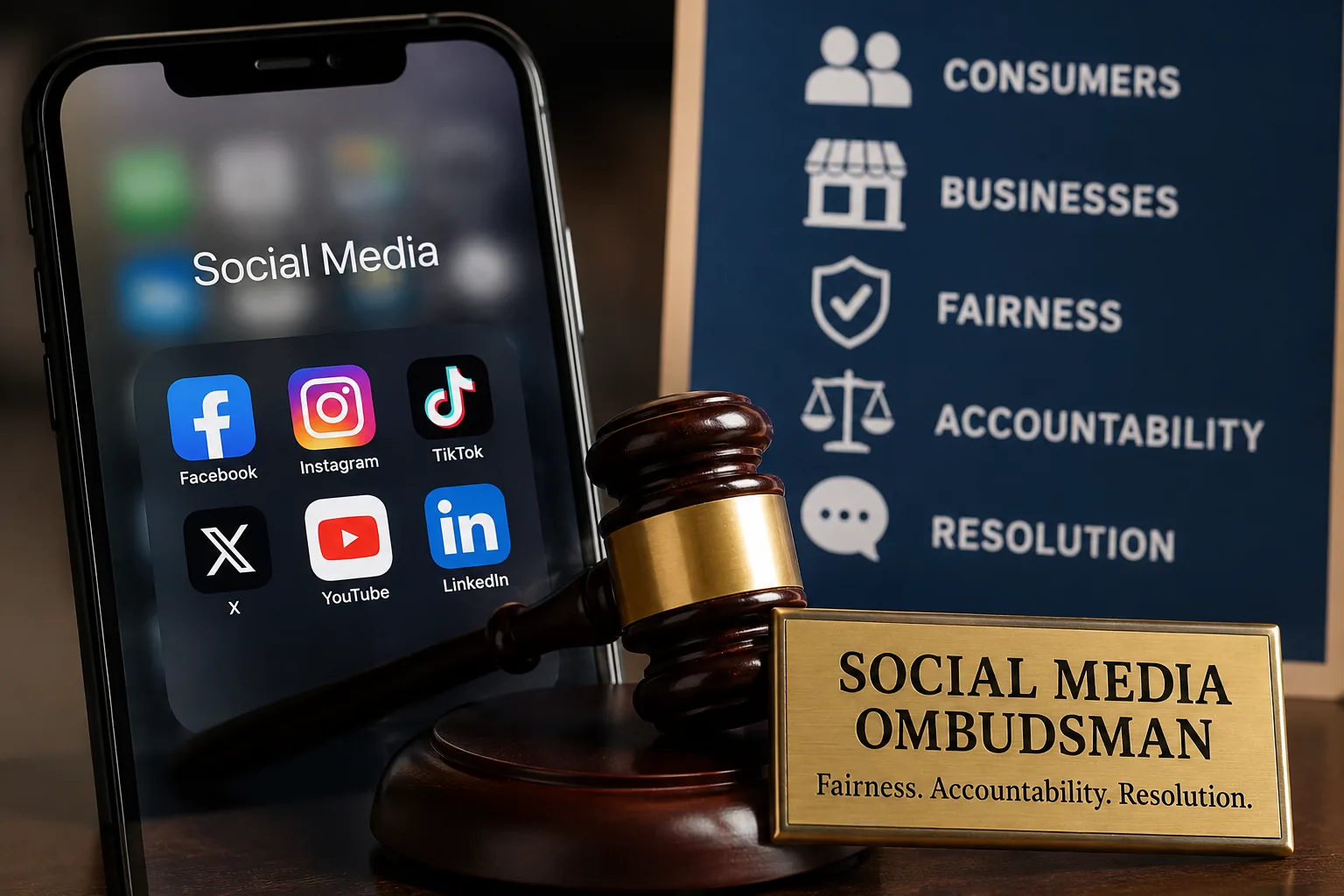
I recently read a story about an Australian business owner who found herself caught in a dispute with Meta after her social media accounts were reportedly disabled following allegations she says were unfounded.
As I read through the story, I found myself asking a bigger question.
Should Australia establish an independent ombudsman to help businesses and consumers resolve disputes with social media platforms?
It's a question that probably would have sounded strange ten years ago.
Today, I'm not so sure.
Australians are familiar with independent dispute resolution schemes.
If you have a dispute with your telecommunications provider, there is the Telecommunications Industry Ombudsman.
If you have a dispute with a bank, insurer or financial services provider, there is AFCA.
These organisations exist because there is often a significant imbalance between large organisations and individual consumers or small businesses.
They provide an independent avenue for complaints, reviews and dispute resolution.
The question is whether social media platforms have become important enough to warrant similar oversight.
Twenty years ago, social media was largely about connecting with friends and sharing photos.
Today it is something very different.
Businesses rely on social media platforms to market products, communicate with customers and generate sales.
Creators earn income through these platforms.
Community organisations use them to engage supporters.
Consumers use them to access information, communicate and participate in public conversations.
For many businesses, losing access to a major social media platform can have real financial consequences.
For consumers, losing access can mean losing years of personal content, connections and digital history.
These platforms have become deeply embedded in modern life.
One of the biggest criticisms levelled at major social media platforms is the lack of transparency around decision making.
Accounts can be suspended.
Content can be removed.
Pages can be restricted.
Advertising accounts can be disabled.
In some cases, users struggle to understand why decisions were made or how they can appeal them.
To be clear, platforms absolutely need the ability to remove harmful content and enforce their terms of service.
The challenge is ensuring there is a fair process when mistakes occur.
As someone who has worked in technology-related industries for many years, I understand that automated systems are often necessary when dealing with billions of users and pieces of content.
But when a decision has a significant impact on a business or individual, there should also be a pathway for meaningful review.
This is where I think the strongest argument exists.
Many small businesses now rely heavily on social media platforms to reach customers.
When an account is suspended or restricted, the consequences can be immediate.
Revenue can disappear overnight.
Advertising campaigns can stop.
Customer communication channels can be disrupted.
Unlike large corporations, many small businesses don't have dedicated account managers or direct access to platform representatives.
An independent dispute resolution process could provide a practical mechanism for reviewing decisions and ensuring businesses are treated fairly.
I believe this question deserves equal attention.
Consumers are increasingly affected by platform decisions as well.
Whether it's account access, content moderation, impersonation issues, privacy concerns or scams, many consumers find themselves dealing with organisations that can be difficult to contact directly.
If an ombudsman were established, should its role extend beyond businesses and provide assistance to individual users as well?
There is a strong argument that it should.
After all, consumers face many of the same challenges as businesses when trying to resolve disputes with global technology companies.
Of course, establishing a social media ombudsman would not be straightforward.
Many of the largest platforms operate globally.
Questions would need to be answered around jurisdiction, enforcement powers, funding and scope.
Should it cover Meta only?
What about TikTok, X, YouTube, LinkedIn and emerging platforms?
What decisions should be reviewable?
Where should platform discretion begin and regulatory oversight end?
These are complex questions.
Personally, I think this debate is worth having.
Social media platforms now play a significant role in the lives of both businesses and consumers.
When disputes arise, there are often limited options available beyond navigating automated support systems and appeal processes.
Whether the answer is a dedicated ombudsman or another form of independent dispute resolution, I believe there is merit in exploring mechanisms that improve transparency, accountability and fairness.
The real question may not be whether social media platforms should have greater oversight.
It may be whether their influence on society has already become large enough that some form of independent oversight is inevitable.
I'd be interested to hear what others think.
Should Australia establish a social media ombudsman for businesses?
And if we do, should consumers be protected too?