07 Oct 2026
12 October, 2026
Monday
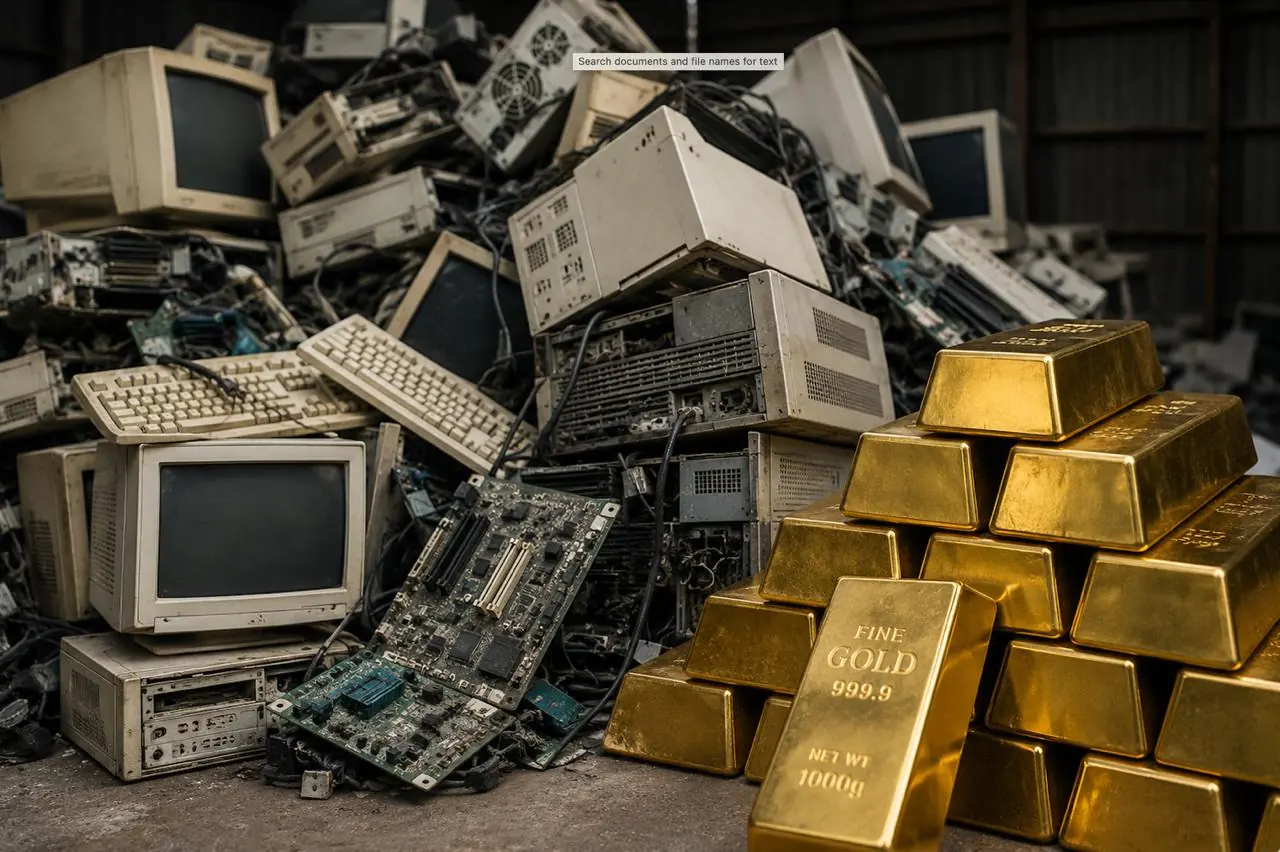
When most people think about gold mining, they picture enormous open-cut mines, underground tunnels and giant haul trucks moving tonnes of rock across the Australian outback.
Very few of us would think about an old computer sitting in a garage, a broken printer gathering dust in the shed or a mobile phone forgotten in the back of a drawer.
Yet that's exactly where one of the world's richest sources of precious metals may already exist.
I was reminded of this after recently watching a report highlighting how old electronic waste is being transformed into a valuable resource. What surprised me was learning that some discarded circuit boards can contain higher concentrations of gold than the ore mined from many gold deposits. Suddenly, electronic waste didn't look like rubbish anymore. It looked like a resource.
Companies are now recovering those precious metals using innovative technologies, turning yesterday's discarded electronics into tomorrow's raw materials.
What fascinated me most, however, wasn't the technology.
It was the memory of a conversation I had many years ago.
Many years ago, I visited a company that specialised in buying old government and corporate computer equipment.
Their business was straightforward. Large organisations would replace ageing computer systems, servers and networking equipment and, rather than sending it all to landfill, the company would refurbish what was still useful and resell it.
While walking through the warehouse, something caught my eye.
In the corner was a huge pile of old computer equipment. Not the three-year-old servers businesses were still buying for their data centres, but ageing mainframe computer systems from decades earlier. As someone with a long interest in computing, I immediately recognised what I was looking at. These were the giants of the computing world from the 1970s and 1980s. The sort of machines that occupied entire rooms, represented the cutting edge of technology and cost hundreds of thousands, sometimes millions, of dollars. At the time, owning a system like this was beyond the reach of all but the largest corporations and government departments.
Looking at the pile, I made an offhand comment.
"It's amazing to think that all of that was worth a fortune once, and now it's just junk."
The manager smiled.
"Actually," he replied, "that's the most valuable pile of equipment in the warehouse."
I must have looked confused.
He explained that a specialist would regularly visit. Not to buy the computers themselves, but to recover the precious metals hidden inside them.
Those obsolete machines contained significant amounts of real gold in their circuit boards, connectors and other electronic components. Once recovered, that gold could be sold, making that forgotten pile of ageing hardware worth considerably more than the newer refurbished equipment they sold every day.
He then shared something that has stayed with me ever since.
For years, they had treated equipment like this as electronic waste. Once they understood its true value, they began rescuing older machines before they reached landfill. Instead of seeing obsolete computers as rubbish, they saw them as a source of valuable raw materials.
That conversation changed the way I looked at old electronics forever.
That experience came back to me because the challenge has only grown.
Every year, millions of computers, mobile phones, televisions, servers, networking devices and household electronics reach the end of their useful lives. Most people think of them simply as rubbish.
But they're anything but.
Inside these devices are valuable resources including gold, silver, copper, palladium, platinum, cobalt, nickel and other critical minerals that modern technology depends upon.
Unlike traditional mining, these materials have already been extracted from the earth.
We've simply distributed them throughout homes, offices and businesses around the world.
Perhaps it's time we started thinking differently about mining.
Instead of looking deeper underground for the resources we need, perhaps we should first look at what we've already mined.
This idea has become known as urban mining, recovering valuable materials from products that have reached the end of their lives rather than extracting new resources from the earth.
It's a remarkably simple concept.
Recovering metals from discarded electronics reduces waste, keeps valuable resources in circulation and lessens the pressure to extract more raw materials from the environment.
Rather than viewing electronic waste as the end of a product's life, urban mining sees it as the beginning of another.
I suspect most households have one.
A drawer containing old mobile phones.
A broken laptop.
Old hard drives.
Chargers that no longer fit anything.
Perhaps even an old desktop computer that's been sitting in the garage for years.
We keep them because we're not quite sure what to do with them. Some people worry about the personal data still stored on them. Others simply never get around to disposing of them.
Ironically, while we're concerned about the information stored inside those devices, we rarely stop to consider the valuable materials stored inside them as well.
Technology evolves at an extraordinary pace.
What was revolutionary twenty years ago is often obsolete today.
What once cost hundreds of thousands of dollars can eventually end up stacked in a warehouse, sitting in a storeroom or gathering dust in someone's garage.
But obsolete doesn't necessarily mean worthless.
Sometimes it simply means we've been looking at it the wrong way.
For generations, we've looked underground for the resources that power modern life.
Perhaps the next generation won't need to look quite so far.
The metals needed to build tomorrow's technology may already be sitting in garages, office storerooms, warehouses and forgotten drawers around the world, waiting to be recovered and used again.
The conversation I had in that warehouse all those years ago taught me something I didn't expect. The value of those old mainframes hadn't disappeared when they became obsolete, it had simply changed.
We often refer to old computers and electronics as electronic waste.
After reflecting on that experience, I can't help but wonder if we've been calling it the wrong thing.
Perhaps it isn't waste at all. Perhaps it's one of the most valuable resources we've already mined.