07 Oct 2026
12 October, 2026
Monday
The other day I watched a comedy sketch on YouTube that made me laugh.
Then it made me think.
The sketch, by American comedians Harris Alterman and Joe Nunnink, shows a customer walking into a shop and encountering the person behind the counter. Instead of simply having a conversation, both of them rely on ChatGPT to tell them what to say to each other.
The shop attendant greets the customer.
Suddenly the customer doesn't know what to do.
He pulls out his phone and asks ChatGPT how he should respond. ChatGPT suggests an ordinary response, so he follows the advice.
Then the person behind the counter is faced with the same dilemma. The customer has responded to him. What should he say now?
Out comes his phone.
Back to ChatGPT.
The interaction becomes increasingly ridiculous as two people standing directly in front of each other use artificial intelligence to work out how to have a perfectly ordinary human conversation. Eventually, a misunderstanding created through the lack of context sends the situation completely off the rails.
It's clever comedy.
But after I finished laughing, I started thinking about what the sketch was actually saying.
And suddenly it wasn't quite as funny.
Artificial intelligence has become extraordinarily useful remarkably quickly.
We can ask AI to help write an email, explain a complicated subject, research an idea, analyse information, plan a holiday, troubleshoot a computer problem or simply help us organise our thoughts.
I use AI myself, and I think it has enormous potential.
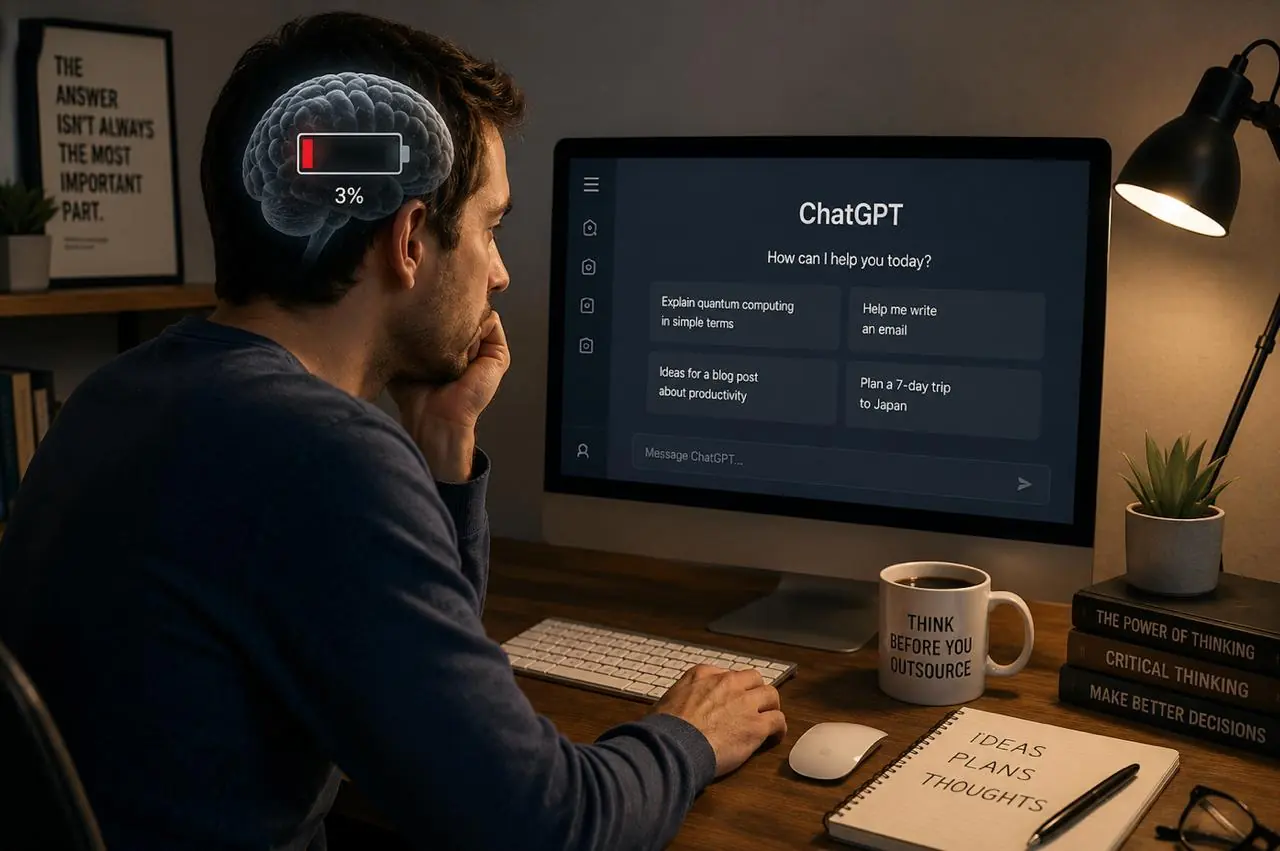
But there's an important difference between using artificial intelligence as a tool and allowing it to become a substitute for our own intelligence.
The comedy sketch exaggerates that idea to make us laugh, but perhaps the exaggeration isn't as ridiculous as we'd like to think.
How often are people beginning to reach for AI before they've even attempted to solve something themselves?
At what point does assistance become dependence?
Technology has been changing the way we think for generations.
Calculators meant we didn't need to perform every calculation in our heads.
Spellcheck helped us correct our spelling.
GPS meant we no longer needed to memorise every street or carry a road map in the car.
Search engines gave us access to an extraordinary amount of information without needing to remember where to find it.
None of these technologies destroyed human intelligence.
They became tools that allowed us to do things faster and often better.
AI should be no different.
But there is one important distinction.
With calculators we outsourced calculation.
With GPS we outsourced navigation.
With search engines we outsourced finding information.
With artificial intelligence, we now have the ability to outsource something much more fundamental.
Our thinking.
When we're faced with a difficult problem, there's value in working through it ourselves.
We consider different possibilities.
We make mistakes.
We reconsider our assumptions.
We change our minds.
Sometimes we discover that we've been asking the wrong question in the first place.
Eventually we might arrive at an answer.
But the answer isn't necessarily the most valuable part of that process.
The thinking that got us there is what taught us something.
If we immediately ask AI for an answer every time we're confronted with a problem, we risk removing that process.
And that creates another problem.
How do we know when AI is wrong?
To challenge an answer, we need enough knowledge and reasoning ability to recognise that something doesn't make sense.
Thinking isn't simply how we arrive at an answer. Thinking is how we learn to recognise whether an answer makes sense.
This takes me back to one of the oldest principles in computing.
Garbage in, garbage out.
Computers have always been dependent on the information and instructions we give them.
Artificial intelligence may be extraordinarily sophisticated, but the principle hasn't disappeared.
Ask a poorly constructed question, leave out important context or make an incorrect assumption and you can receive an answer that sounds perfectly convincing while being completely wrong.
The comedy sketch demonstrates this beautifully.
The AI doesn't have the benefit of standing in the shop.
It can't see the other person.
It doesn't automatically understand the context of everything happening around the conversation.
It works with what it has been told.
The humans standing in the room have something the AI doesn't.
They have the entire situation happening directly in front of them.
Yet in the sketch, they trust the information on their phones more than their own eyes, ears and common sense.
That's where the comedy becomes an interesting warning.
None of this means we should stop using artificial intelligence.
Quite the opposite.
Used properly, I believe AI can be one of the most powerful thinking tools we've ever created.
The difference comes down to how we use it.
Instead of asking AI:
"What should I think?"
Perhaps ask:
"What am I missing?"
Instead of:
"Make this decision for me."
Ask:
"What are the arguments for and against this decision?"
Instead of simply asking:
"Give me the answer."
Try:
"Here's what I think. Challenge my reasoning."
Suddenly AI isn't replacing your thinking.
It's helping you think.
That distinction matters.
There's enormous discussion today about the skills people will need in an AI-powered world.
We hear about prompt engineering, AI literacy and learning how to use increasingly sophisticated tools.
Those skills will undoubtedly be important.
But perhaps there's another skill that will become even more valuable.
Knowing when not to use AI.
There are problems we should occasionally struggle with ourselves.
There are decisions we should think through.
There are conversations we should have without assistance.
There are ideas that should begin inside our own heads.
And sometimes when somebody standing directly in front of us says hello, perhaps we should simply say hello back.
I laughed when I watched that comedy sketch.
Two people standing only metres apart, both perfectly capable of speaking to each other, staring at their phones and asking artificial intelligence how they should communicate with the human directly in front of them.
It's absurd.
At least, I hope it remains absurd.
Artificial intelligence has the potential to become one of the most useful technologies we've ever created. It can help us work faster, explore ideas, understand complicated subjects and challenge the way we think.
We should use it.
But we should never forget what the word artificial means.
AI should help us think.
It should never stop us thinking for ourselves.
This hilarious comedy sketch can be seen at: