07 Oct 2026
12 October, 2026
Monday
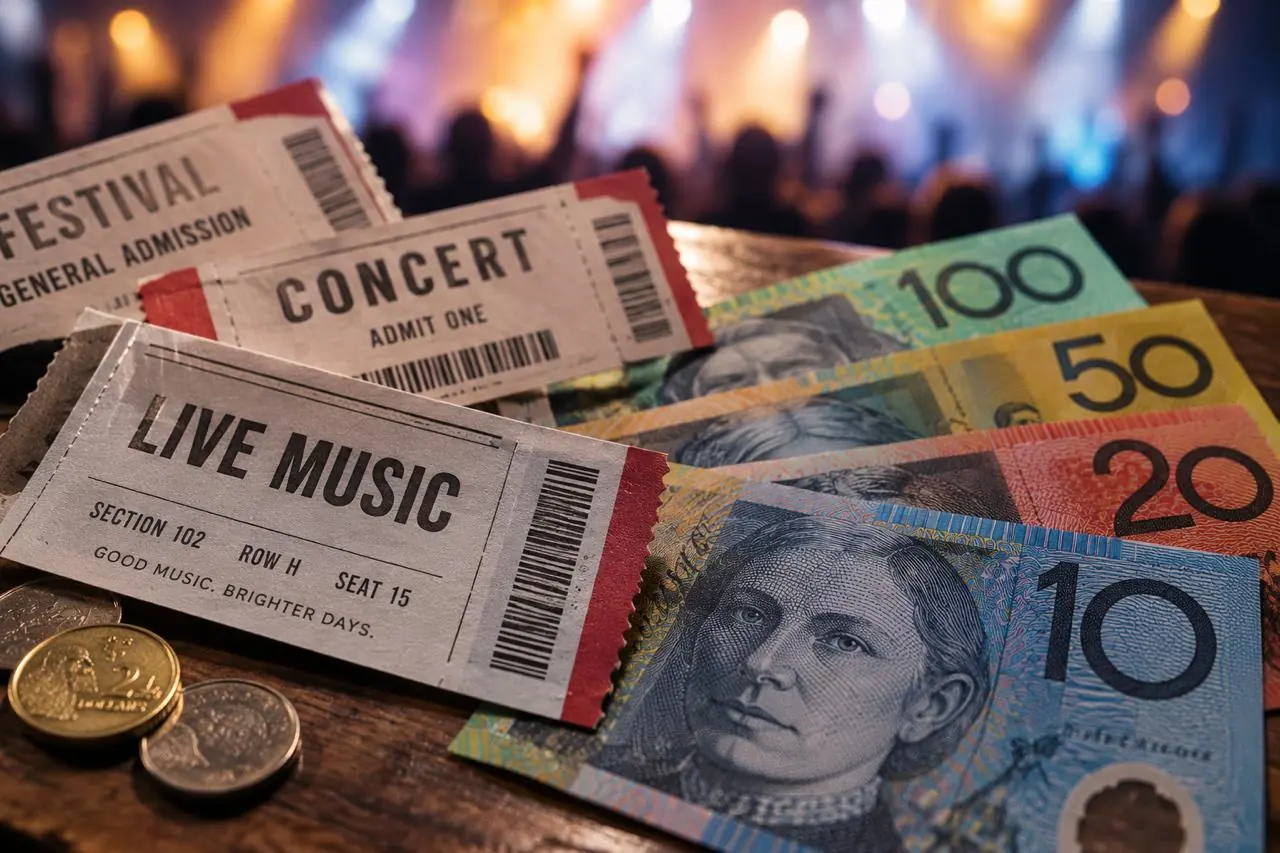
Something has felt slightly strange about 2026.
I love live music, and normally by this point in the year there would have been several major concerts I had either attended, considered attending or regretted not buying tickets for. This year feels different. It isn't that there haven't been concerts, because there certainly have. Sydney's live music calendar is far from empty. But when I think about the major international artists and events I would normally expect to see appearing throughout the year, 2026 somehow feels unusually quiet.
What makes it even more noticeable is that every time another major tour announcement appears, it seems to have 2027 attached to it.
Radiohead are returning to Australia for the first time in 15 years. Bruno Mars has announced a huge Australian stadium tour. Fatboy Slim is coming back and doing three consecutive nights at Carriageworks in Sydney.
But they're all coming next year.
It made me wonder whether what I was noticing was real.
What happened to concerts in 2026?
Part of what made me start thinking about this wasn't actually concerts at all.
I've noticed the same thing with some of the annual events and parties that would normally form part of my Sydney entertainment calendar. Several events I would ordinarily expect to attend simply aren't happening this year. The annual Halloween party has been paused, as has the MG after party.
Individually, that doesn't necessarily mean very much. Events take breaks for all sorts of reasons. Organisers change direction, venues become unavailable, circumstances change and sometimes people simply need a year off.
But when you start combining those absences with a concert calendar that has felt noticeably lighter, while major announcements for 2027 begin accumulating, it starts to feel like something worth investigating.
Perhaps 2026 isn't the year Australians stopped wanting live entertainment.
Perhaps it has become something of a pause year.
There is another change I've noticed this year, and this one has come from people actually organising events.
I've heard event organisers talk about unusually slow advance ticket sales. An event can appear to be struggling weeks beforehand, creating understandable anxiety for the people putting it together, only for sales to suddenly accelerate much closer to the date.
This isn't simply anecdotal. Creative Australia has identified later ticket purchasing as a significant change in audience behaviour. Its research into Australian music festivals found that people buying tickets closer to an event creates considerable uncertainty for organisers trying to work out whether an event will even reach break-even point.
Think about what that means for somebody organising an event.
The audience might be waiting until the final week to decide whether to go. The organiser doesn't have that luxury.
The venue needs to be booked. Artists need to be confirmed. Production needs to be organised. Security, equipment, staff, advertising and insurance may all need to be committed to long before anybody knows how many people are actually going to walk through the door.
An event that eventually attracts a perfectly healthy crowd can therefore look financially disastrous a month beforehand.
And if you're the person risking the money, how many times are you prepared to gamble on everyone turning up at the last minute?
Cost almost certainly has something to do with it.
Creative Australia's latest national research found that cost is now the biggest barrier preventing Australians from attending arts events. Sixty per cent identified ticket or entry costs as a barrier, while 55 per cent said they had missed events they wanted to attend because of the cost.
For live music specifically, the ticket is only part of the equation.
There might be transport, parking, dinner, drinks, accommodation and sometimes travel to another city. A night out that once felt like an easy decision can become a significant discretionary purchase.
There are also plenty of perfectly ordinary reasons to wait. People might want to see what their friends are doing. They might be waiting for payday. For an outdoor event, they may want some idea of what the weather will be like. Others might simply be reluctant to commit to something months away when they don't know what else will be happening that weekend.
None of these decisions seems particularly significant when made by one person.
Multiply them across several thousand potential customers and they become enormously significant to an event organiser.
Perhaps Australians haven't stopped spending money on live entertainment.
We may simply have become much more selective about what deserves our money, and when we're prepared to hand it over.
From the audience's perspective, waiting makes perfect sense.
From the organiser's perspective, however, all of those perfectly rational individual decisions add up to an enormous problem.
Creative Australia's festival research found that changing ticket-buying behaviour doesn't simply create uncertainty. It can affect marketing expenditure, insurance decisions and revenue from other areas of an event.
There is an uncomfortable cycle hiding in there.
Audiences become cautious and delay buying tickets. Organisers see weak advance sales. Weak advance sales make events financially riskier. Organisers become cautious about committing to the next event.
Eventually, some events simply don't happen.
I'm not suggesting that this explains every cancelled or paused event in 2026. It certainly doesn't. There can be completely unrelated reasons why an event takes a year off.
But it helps explain how an entertainment calendar can begin to feel thinner even when people still want to go out.
At exactly the same time audiences are watching their spending, the people putting on the events are facing rising costs of their own.
Venue hire, production, equipment, performers, staff, security, insurance, marketing and transport all contribute to the cost of staging an event. Creative Australia's research into Australian music festivals identifies rising operational costs among the significant pressures facing the sector.
That creates pressure from both directions.
The organiser needs to charge enough to make the event viable.
The audience needs the ticket to remain affordable enough to justify going.
Somewhere between those two numbers sits the event itself.
Australia has another complication when it comes to international touring. We are a long way from almost everywhere.
Bringing a major international production here means moving performers, crew and equipment enormous distances to reach a country with a relatively small population spread across a handful of major cities. The economics have always been unusual. When touring and production costs rise, those calculations become even more important.
It isn't difficult to understand why international artists might increasingly think about Australia as part of a carefully planned Asia-Pacific touring schedule rather than simply adding a few Australian dates whenever there is a gap in the calendar.
There is also a danger in looking only at stadiums and arenas.
Australia's live music industry is producing a curious split.
At the top end, major artists can still attract enormous audiences. At the other end, grassroots and smaller live-music venues have been struggling with rising costs and changing consumer habits. Music Australia has reported growth in attendance at major venues and festivals while smaller venues and grassroots live-music settings remain under pressure.
That matters because those smaller places are where so much of live music begins.
They're where new artists learn how to perform. They're where audiences discover bands before everyone else knows their names. They're where somebody can decide on a Friday afternoon to see some music that evening without treating the decision like a major financial investment.
Perhaps that is part of what feels different.
At one end of the market we increasingly have the event: enormous production, international superstar, expensive ticket and months of anticipation.
At the other we have a grassroots live-music sector fighting to remain viable.
What happens to everything in between?
There was a time when seeing a musician primarily meant going somewhere to watch them perform music.
Of course, spectacular concerts aren't new. Pink Floyd didn't exactly travel with a guitar and a couple of spotlights. Madonna, U2, Michael Jackson and countless others spent decades turning concerts into enormous theatrical productions.
But technology has allowed that spectacle to reach another level.
Giant video walls, elaborate staging, enormous lighting rigs, moving platforms, pyrotechnics and huge touring crews have transformed the biggest concerts into extraordinary experiences.
They're also expensive experiences.
That raises an interesting question about whether the live entertainment industry has inadvertently created an arms race.
Audiences expect more because tickets cost more. Productions become bigger to justify those ticket prices. Bigger productions cost more to tour. Those costs contribute to higher ticket prices.
Eventually, attending a major concert becomes something people save for rather than something they simply decide to do.
There is nothing inherently wrong with that. Some of the greatest concerts I've attended have been enormous productions, and there is something extraordinary about seeing tens of thousands of people sharing the same experience.
But perhaps we have reached a point where the spectacular has become easier to sell than the ordinary.
This is where the idea that Australians have simply lost interest in concerts starts to fall apart.
Because while I've spent much of 2026 wondering where all the concerts have gone, my 2027 calendar is already beginning to look remarkably crowded.
Bruno Mars is a striking example. His Australian tour currently stretches across 12 stadium concerts in Sydney, Melbourne, Brisbane and Perth, including four shows at Sydney's Accor Stadium. These aren't small theatres being booked for several nights. They are stadiums.
Radiohead are taking another extraordinary approach. Their first Australian concerts in 15 years will comprise 16 shows across Perth, Melbourne and Sydney, including six Sydney performances.
Then there is Fatboy Slim, who is doing something completely different again. Instead of one enormous Sydney stadium show, he will take over Carriageworks for three consecutive nights in March 2027, an exclusive Sydney residency that will also be his only NSW stop on the tour.
These aren't isolated announcements. They're beginning to create the strange impression that Australia's live entertainment calendar has somehow skipped ahead a year.
And here's the really interesting part.
We're being asked to buy the tickets now.
That creates a fascinating contradiction.
On one hand, event organisers are reporting that audiences are increasingly reluctant to commit to tickets far in advance.
On the other, major international artists are putting concerts on sale many months before they arrive, sometimes adding multiple performances in the same city to satisfy demand.
So perhaps saying that people no longer buy tickets early is too simplistic.
Maybe the real change is that people have become much more selective about which tickets they're prepared to buy early.
If Radiohead are returning after a 15-year absence, there is an obvious sense of scarcity. Miss them this time and who knows when you'll get another opportunity.
Bruno Mars playing multiple Australian stadium dates creates another kind of major cultural event. If everybody around you is talking about going, the decision can become less about whether you want to see a concert and more about whether you want to miss the experience.
Fatboy Slim's three-night Carriageworks residency uses scarcity in a different way. Rather than simply putting on another arena concert, the venue and residency format make the performances themselves feel distinctive.
Compare that with an annual party or event that people assume will return next year.
Perhaps that's where the psychology changes.
If money is tight and you have $300 or $400 available for entertainment, do you spread it across several smaller events, or save it for the artist you've wanted to see for years?
Increasingly, I suspect many people are choosing the latter.
Maybe this is the larger cultural change underneath all of this.
For years, live entertainment was simply part of going out. You went to gigs. You went to parties. You went dancing. Sometimes you knew exactly what you were going to see and sometimes you simply went because your friends were going.
Now we seem to be moving towards something slightly different.
We're not simply going out.
We're increasingly going to something.
Something worth putting in the calendar months beforehand. Something worth paying a significant amount of money for. Something that feels special enough to justify the expense.
That is wonderful for the Bruno Marses and Radioheads of the world.
It is potentially much more difficult for the smaller promoter wondering whether enough people will buy a ticket to next month's party.
And perhaps that helps explain why some familiar annual events can suddenly disappear for a year.
The more I think about it, the less convinced I am that 2026 is simply a bad year for concerts.
It may instead be a year in which several changes that have been developing for some time have become much easier to see.
Audiences are under financial pressure but haven't stopped valuing experiences. They're becoming more selective. They're buying some tickets later. Yet when something feels genuinely special, scarce or unmissable, they can still be persuaded to commit months in advance.
Meanwhile, organisers are being asked to take financial risks earlier while much of their audience commits later.
That's an uncomfortable combination.
It may also help explain why I've found myself looking at the calendar this year and wondering where everything went.
Some annual events I expected to attend have taken a year off. Some organisers I've spoken with have watched advance sales crawl before people finally committed closer to the event. The international touring calendar has felt quieter to me, yet announcements for next year keep appearing.
Then I look at 2027 and see Bruno Mars booking Australian stadiums night after night, Radiohead returning for 16 shows and Fatboy Slim settling into Carriageworks for three nights.
Clearly, we haven't fallen out of love with live entertainment.
Perhaps we've simply changed the way we value it.
There was once a time when buying a concert ticket or deciding to go to a party could be a relatively casual decision. Increasingly, it feels like we're making choices. Which artist is worth the money? Which event is special enough? Which experience might not come around again?
That creates a challenge for an industry built around selling tickets before the show actually happens.
For audiences, waiting until the last minute might simply feel like sensible budgeting.
For the person deciding whether to put the event on next year, those empty seats on the booking chart three weeks beforehand can tell a very different story.
Maybe that's the strange thing about live entertainment in 2026.
We haven't stopped wanting to go out. We've just become much harder to convince to buy the ticket.