07 Oct 2026
12 October, 2026
Monday
Over the weekend I was helping with the Sydney Lindy Exchange (SLX), an event that brings together people who share a love of swing dancing and the music that goes with it.
At various moments throughout the weekend, I found myself standing at the side of a crowded dance floor watching people move to music that was written and recorded generations ago. There was something quite wonderful about it. For a moment, I tried to imagine what a similar dance floor might have looked like when this music wasn't nostalgic at all. It was simply the popular music of the day.
Imagine being young in the 1930s or 1940s, going out with your friends and hearing the big bands of Count Basie, Duke Ellington, Benny Goodman or Chick Webb. This wasn't music being lovingly preserved from another era. It was new. It was exciting. It was the music people danced to, fell in love to and probably got into trouble to.
Decades later, people who weren't even born when many of those recordings were made are still dancing to them.
Watching all of this made me wonder about something I have thought about many times before.
Why do we love the music we love?
Everyone's taste is different. A song that can make one person stop whatever they're doing and turn up the volume can leave somebody else completely unmoved. Some people love jazz, others rock, country, classical, disco, hip-hop or electronic music. Most of us have songs we adore that somebody close to us simply cannot understand.
Yet I have also noticed something else. For many of us, the music we listened to during our teenage years and early adulthood seems to hold a particularly powerful place in our lives.
And it turns out there may be a reason for that.
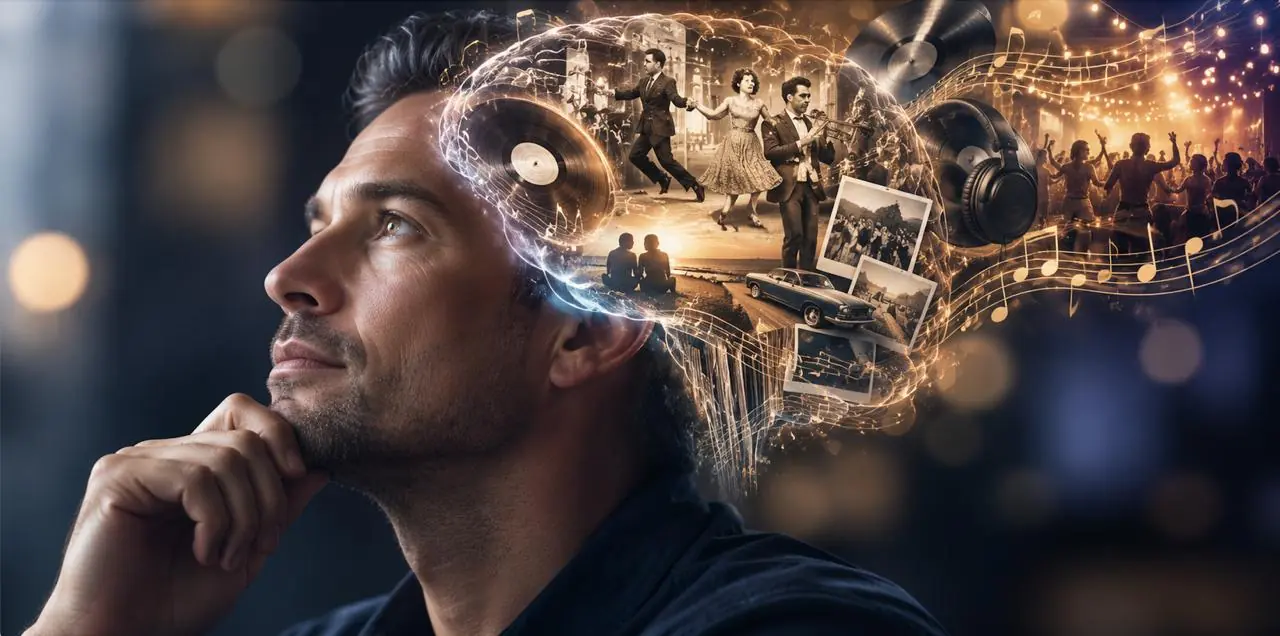
Psychologists have long observed something known as the reminiscence bump. As people get older, memories from adolescence and early adulthood can be disproportionately prominent among the autobiographical memories they recall.
It makes intuitive sense when you think about what is happening to us during those years.
Our late teens and twenties are often when we begin separating from the world our parents created for us and start building one of our own. We gain independence. We leave school, begin working or studying, start going out, form adult friendships and experience serious relationships. We might fall in love for the first time, have our hearts broken for the first time, travel without our families or discover communities where we finally feel that we belong.
Perhaps most importantly, we are beginning to work out who we are.
And through an extraordinary amount of that experience, music is playing.
There is a song from the first nightclub you went to. An album you played endlessly after a relationship ended. A song everyone sang on a particular holiday. The music playing in your first car. The band you discovered with your friends. The record that your parents hated, which probably made you like it even more.
Eventually those songs stop being simply pieces of music.
They become attached to people, places and experiences.
Perhaps we don't simply attach ourselves to music.
We attach music to ourselves.
Most of us have experienced it. A song comes on that you haven't heard for twenty or thirty years and something happens almost immediately.
You know the words. Sometimes you can remember where you used to listen to it. You might think about somebody you haven't thought about for years. A particular summer returns. A nightclub that no longer exists suddenly feels strangely close again. Sometimes the emotional response arrives before you've even consciously worked out why the song matters.
That may help explain why discovering new music as we get older can feel different.
It certainly doesn't mean we stop appreciating new music. We can discover an extraordinary artist at 40, 50, 60 or 70 and genuinely love what they create. But a brilliant song you discover today is competing with another song that has had thirty years to collect pieces of your life.
A song you loved when you were 19 might contain your first love, your friends, your first car, a particular summer and a version of yourself that no longer exists.
The new song might be every bit as good.
It just doesn't have thirty years of your life attached to it yet.
This brings me back to SLX.
If our strongest musical connections are often formed during our youth, why were people spending an entire weekend enthusiastically dancing to music created decades before many of them were born?
I think the answer reveals something important.
Perhaps it isn't necessarily the age of the music that matters. Perhaps it is our age when that music becomes important to us.
Someone born in the 1990s obviously has no personal memory of walking into Harlem's Savoy Ballroom in the 1930s. But imagine that person discovering swing music and Lindy Hop when they're 19.
Suddenly those old recordings become the soundtrack to something entirely new. They learn to dance. They make friends. They travel to exchanges. They meet partners. They stay out far too late dancing. They have wonderful nights and terrible nights. They become part of a community.
The recording might have been made in 1938.
The memories attached to it might have been made in 2026.
That means the same piece of music can become part of completely different lives separated by generations. For someone who danced to it when it was first released, it might recall their youth in the 1940s. For somebody dancing to it today, it could eventually remind them of their own twenties.
The song belongs to both of them. The memories are entirely their own.
There is another reason our tastes are so different.
We don't discover music in a vacuum.
Our parents introduce us to music before we're old enough to choose it ourselves. Brothers and sisters influence us. Friends introduce us to artists. Romantic partners bring their music into our lives. Films and television can resurrect songs from decades earlier and introduce them to an entirely new generation.
Sometimes we become attached to a genre because we become attached to the community around it.
Swing dancing is a perfect example.
At SLX, the music wasn't simply being consumed through headphones. People were moving to it together. They were interpreting it physically, responding to another person and sharing the experience with an entire room.
Music in that environment becomes attached to movement, touch, friendship, community and belonging.
Perhaps that's part of why trying to explain our musical taste can be so difficult.
We aren't necessarily explaining why we like a particular collection of sounds.
We're explaining a little bit of ourselves.
Perhaps one of the most extraordinary demonstrations of the relationship between music and memory has come from research involving people living with Alzheimer's disease.
A 2018 study involving researchers at Macquarie University here in Sydney examined autobiographical memories triggered by music. Participants with Alzheimer's disease and a group of healthy older adults were exposed to famous songs and photographs associated with different decades.
The researchers were particularly interested in what happened when the material came from the period when participants had been between 10 and 30 years old.
Music from that period triggered more memories than music associated with later decades, and the effect was statistically significant for the music-evoked memories. Remarkably, the researchers also found that the frequency of music-evoked autobiographical memories did not differ significantly between the Alzheimer's group and the healthy older participants, even though the Alzheimer's group showed a decline in memories prompted by photographs.
The researchers described the findings as supporting the idea that music-evoked autobiographical memories may represent an "island of preservation" as Alzheimer's disease progresses.
There have also been attempts to put personalised music into practice in nursing homes. A large American study looked at almost 13,000 residents with Alzheimer's disease or related dementias across 98 nursing homes participating in a program called MUSIC & MEMORY. Rather than simply playing generic old music, carers created playlists based on each resident's own history and musical preferences. The study found associations with reductions in behavioural problems and some medication use, although the researchers were careful about the limitations of the evidence.
We shouldn't turn those findings into the romantic claim that playing an old song somehow reverses dementia. It doesn't.
But there is something profoundly moving about the possibility that when other pathways to our past become difficult to access, a familiar melody can sometimes still find its way through.
Perhaps those songs weren't simply playing in the background while we were becoming adults.
Somehow, they became part of the way we remember who we were.
That thought takes me back again to the dance floor I was watching over the weekend.
Some of the music being played was created more than eighty years ago.
The young people who first danced to those songs lived in a completely different world. Their lives unfolded through wars, marriages, children, careers, triumphs and losses. For those who lived long enough, perhaps hearing one of those recordings many decades later transported them back to a dance hall and a younger version of themselves.
Today another generation is dancing to the same music.
They are creating completely different friendships, relationships and memories around exactly the same recordings.
And perhaps decades from now, somebody who danced at SLX this weekend will hear one of those songs again.
They won't be remembering 1938.
They might be remembering 2026.
They might remember the room, the people they danced with, the friends who were there and what it felt like to be that particular age.
The music will have travelled almost a century, but the memory will be completely personal.
Music is one of those strange things humans seem to need despite it serving no obvious practical purpose.
We organise sounds into rhythm and melody and then attach extraordinary emotional importance to them. We play music when we're celebrating and when we're grieving. We choose it for weddings and funerals. We use it to exercise, dance, concentrate, relax and sometimes simply to make an ordinary drive home feel a little different.
And somewhere along the way, particular songs become markers in our lives.
That may be why arguing about whether one generation's music was "better" than another's largely misses the point.
Perhaps the music of our youth doesn't necessarily sound better because musicians were more talented, songwriting was superior or records were somehow more authentic.
Perhaps it sounds better partly because we were there.
We were younger. Things were happening for the first time. Our identities were still being formed, and those songs happened to be playing while it was happening.
That doesn't prevent us from discovering new music or falling in love with something recorded decades before we were born. It simply means that when music becomes part of an important period of our lives, it can carry that period with it for years afterwards.
Perhaps that is why the music we loved when we were young never really becomes old music.
The songs haven't changed.
We have.
Somewhere inside those three or four minutes can be a younger version of ourselves, surrounded by people and places that may no longer be part of our lives. Sometimes all it takes is the opening few notes of a song to find them again.
And perhaps that's ultimately why we love the music we love.
We're not always listening to the song. Sometimes we're listening to a memory.