07 Oct 2026
12 October, 2026
Monday
Since the news of Dolly Parton's passing, I have spent some time reading the stories being shared about her life.
Of course, there have been tributes to the music. There could hardly be a discussion about Dolly Parton without Jolene, 9 to 5 or I Will Always Love You. She was one of those rare performers whose songs crossed generations and genres, and whose appearance and personality became instantly recognisable almost anywhere in the world.
But something else has struck me far more than the lists of hit records, awards and career achievements.
Story after story has been about her kindness.
People have talked about her generosity, her humour, the way she treated people and the enormous amount she gave back during her lifetime. In an age when the death of a famous person can sometimes be followed by uncomfortable revelations or a reassessment of the person behind the carefully managed public image, the stories being told about Dolly Parton seem to have done almost the opposite.
The more you learn about the woman behind the rhinestones, the more remarkable she becomes.
And perhaps there is something in her life that all of us can learn from.
One of Dolly Parton's greatest legacies has nothing to do with music.
Dolly grew up as one of twelve children in a poor family in the mountains of East Tennessee. Her father, Robert Lee Parton, was a hardworking and intelligent man, but he had never learned to read or write. Dolly later spoke about how much she admired him and how she believed his inability to read had prevented him from achieving some of the things he might otherwise have accomplished.
Rather than simply reflecting on the unfairness of that, she decided to do something about it.
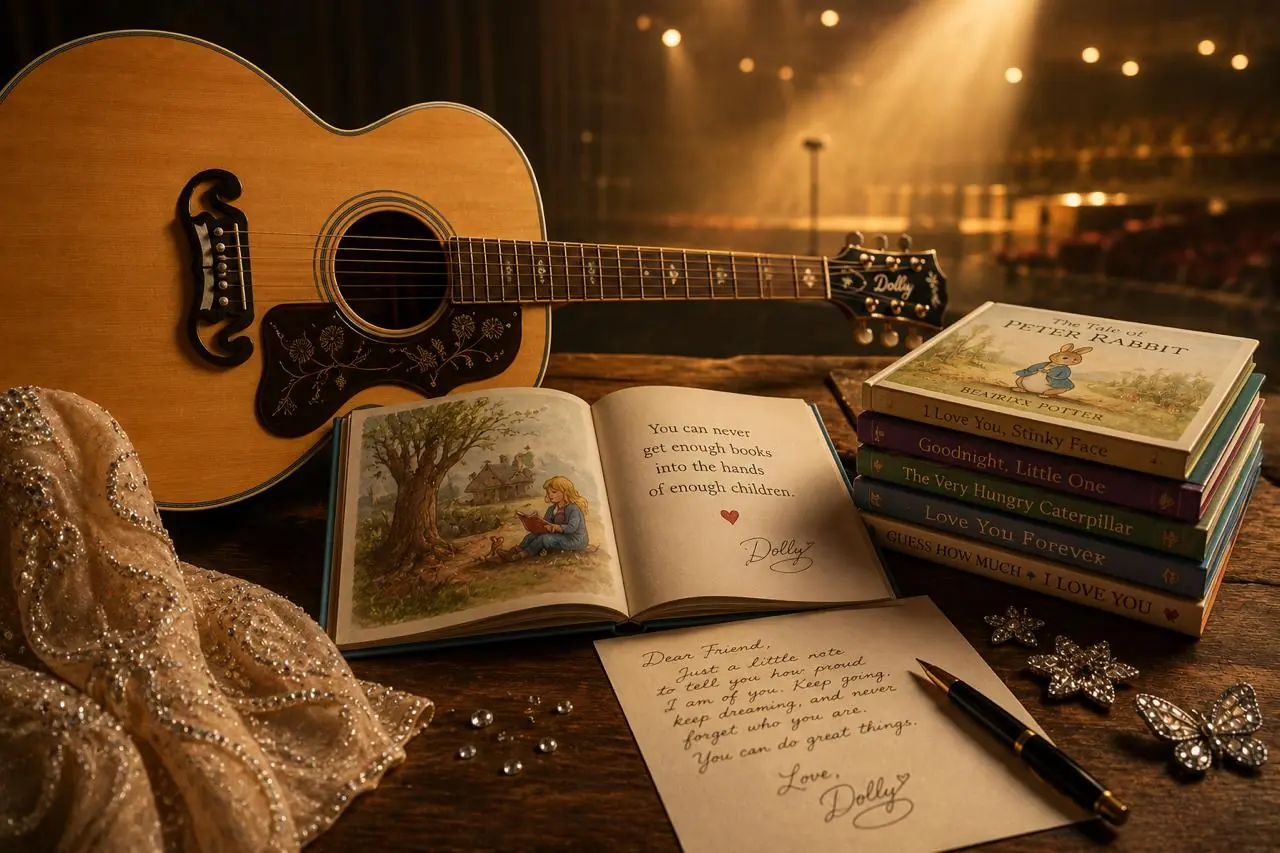
In 1995, she created the Imagination Library, initially for children in the Tennessee county where she had grown up. The idea was wonderfully simple. Children would receive a free, age-appropriate book in the mail every month from birth until the age of five, regardless of their family's income.
What began as a local project grew far beyond anything she could probably have imagined.
Today the program operates across the United States, Canada, the United Kingdom, Ireland and Australia. More than 330 million books have been sent to children around the world, including more than two million here in Australia.
There is something particularly beautiful about the simplicity of it.
Hundreds of millions of times, somewhere in the world, a child has opened the mailbox and discovered a book with their own name on it. Some of those children will have grown up in homes already filled with books. For others, it may have been the beginning of a relationship with reading that their family could never otherwise have afforded to give them.
Dolly understood that a book could be much more than paper and ink. It could be the beginning of an education, an imagination, an ambition or even an entirely different life.
She became known to many children simply as "The Book Lady."
For someone who spent her life making records, that might be one of the most wonderful titles she ever received.
The Imagination Library was only one part of Dolly's philanthropy.
Over the years she gave millions of dollars to causes ranging from children's hospitals and education to disaster relief. After devastating wildfires affected communities around her home region in Tennessee, she helped establish financial support for families who had lost their homes. Following Hurricane Helene, she personally donated US$1 million to relief efforts, with her businesses providing further support.
During the COVID pandemic, Dolly donated US$1 million to research at Vanderbilt University Medical Center. Some of that funding supported work connected with the development of the Moderna vaccine. She later gave another US$1 million to Vanderbilt to support paediatric infectious disease research.
There were smaller ideas too. Years earlier, she offered students in her home county US$500 if they graduated from high school, part of an effort to encourage young people to remain in education.
What I find interesting about these stories isn't simply the amount of money involved.
Plenty of wealthy people donate money to charity.
What seems different about Dolly is how often her generosity can be traced back to something she had personally seen or experienced. Her father's inability to read became a literacy program. The poverty of the community where she grew up became a lifelong commitment to education and opportunity. When disaster struck the region she came from, she helped the families who lived there.
She seemed to look at a problem and ask a very simple question:
What can I do to help?
Yet strangely, some of the stories I have found most moving don't involve millions of dollars or enormous charitable organisations.
They involve letters.
After Dolly Parton and Eminem were both inducted into the Rock & Roll Hall of Fame in 2022, Dolly wrote him a personal letter.
They hadn't met.
She didn't need anything from him, and there was no obvious reason she needed to write at all. She simply wanted to congratulate him.
Dolly admitted that she didn't know a great deal about rap music, but told Eminem that she had come to understand just how good he was at what he did. She encouraged him to continue and reminded him that his work touched people in ways he might not even realise.
Eminem kept the letter.
After Dolly's death, he shared it and explained how much receiving it had meant to him. What struck me most was his observation that Dolly simply didn't have to take the time to do it.
And he's right.
She didn't have to. She simply chose to.
There is another story that I find even more revealing.
At the Academy Awards in 2006, Dolly was nominated for Best Original Song for Travelin' Thru. She lost to Memphis hip-hop group Three 6 Mafia, who won for It's Hard out Here for a Pimp.
Dolly could have applauded politely, smiled for the cameras and gone home.
Instead, she was genuinely delighted for them.
And afterwards, she wrote them a personal letter congratulating them and telling them how happy she was that, one way or another, the Oscar had come home to Tennessee.
Neither of these letters changed the world. They didn't build a hospital, fund medical research or put books into the hands of children.
They were simply acts of kindness.
And perhaps that is exactly why they tell us so much about her.
It's relatively easy to be gracious while standing on a stage accepting an award. Being genuinely happy for the person who received the award instead tells us something more.
Dolly Parton seemed to understand something that can easily be forgotten in a world increasingly obsessed with achievement and competition.
Celebrating somebody else's success doesn't diminish your own.
Dolly's own journey makes all of this even more remarkable.
She went from growing up in poverty in rural Tennessee to becoming one of the most recognisable entertainers in the world. She wrote thousands of songs, sold millions of records, starred in films, created businesses and built an entertainment empire.
She also understood exactly what the public saw when they looked at her.
The enormous blonde hair, the makeup, the rhinestones and the famously exaggerated appearance were all part of the joke, and Dolly was usually the first person laughing.
Behind that carefully created image, however, was an extraordinarily talented songwriter and a remarkably astute businesswoman.
Perhaps one of her greatest achievements was that decades of wealth and celebrity never appeared to erase the memory of where she had come from.
The little girl who grew up poor in Tennessee remained present in so many of the choices the extraordinarily successful woman later made.
Maybe that is another lesson worth remembering.
Success doesn't require us to forget the person we were before we became successful.
In fact, remembering may be one of the best ways to decide what to do with success when it arrives.
We sometimes think making a difference in the world requires enormous wealth or influence.
Most of us cannot give millions of dollars to medical research. We cannot establish an international literacy program that sends hundreds of millions of books to children. We cannot rebuild communities after natural disasters.
But we can write the letter.
We can congratulate somebody else when they succeed.
We can encourage someone who may need to hear that they're good at what they do.
We can remember where we came from. We can help when we see somebody struggling. We can give people our time when there is absolutely nothing in it for us.
Perhaps that is the part of Dolly Parton's legacy that is available to every one of us.
Kindness doesn't necessarily have to be grand to matter.
Sometimes it can be as simple as taking a few minutes to tell another human being that you noticed them.
Dolly Parton leaves behind an extraordinary catalogue of music. Jolene will continue playing. New generations will discover 9 to 5. And I Will Always Love You will probably still be sung long after all of us are gone.
But I wonder whether the greatest tribute to Dolly Parton is what has happened since her death.
People haven't simply been talking about what she achieved.
They've been talking about how she made people feel.
They've remembered the books she gave children, the communities she helped, the people she encouraged and even the letters she took the time to write when she didn't have to.
Somewhere today, a parent will sit beside a child and open a book that arrived because Dolly Parton believed every child deserved the opportunity to learn to read.
That child may never own one of her records. They may never visit Dollywood. They may not even understand why a woman with enormous blonde hair and an even bigger smile decided many years ago that books should arrive in children's letterboxes.
But perhaps that's what makes her legacy so special.
We spend so much of our lives worrying about what we will achieve, what we will own, how successful we will become and what other people will think of us.
Dolly Parton's life offers a slightly different measure of success.
When your life is over, what stories will people tell about the way you treated them?
Dolly spent a lifetime entertaining millions of people, but she also used the success that life gave her to make life a little better for millions of others.
Her family has asked that, instead of sending flowers in her memory, people donate to the Imagination Library.
Even in saying goodbye, the story somehow comes back to the children.
Perhaps the greatest lesson Dolly Parton leaves us is also the simplest.
Whatever success life gives you, never become too important to be kind.